Burnaby reduces by-right multiplex height from four storeys to three
Still 50% better than the city of Vancouver

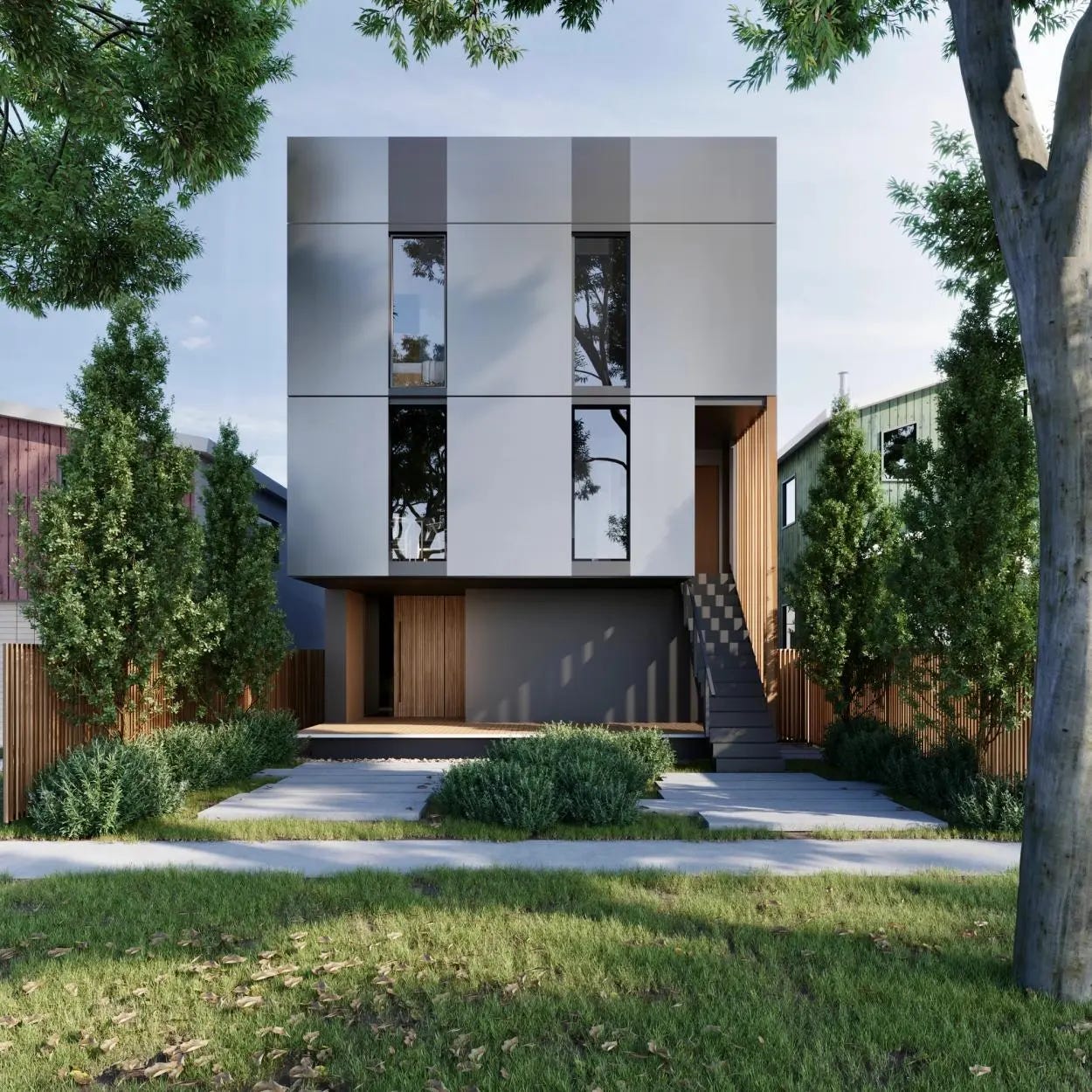
Public backlash to ‘gigantic’ multiplex homes in Burnaby, B.C., has council scaling back. Lauren Vanderdeen, CBC News.
Agenda and video from Burnaby council meeting, Tuesday October 14.
As of last Tuesday, Burnaby is reducing the maximum height of a multiplex to three storeys instead of four. I’m sorry to see this! Up to now, a natural question for the city of Vancouver is, if Burnaby can do this, why can’t we? (It’s still a good question, since Burnaby’s retreat seems to be based entirely on complaints from neighbours, not from any technical difficulties.)
This change reduces the allowable floor space by about 33%, and increases the cost of land by about $100 per square foot of floor space.
What’s legal to build by right?
The big question in each jurisdiction is, what’s legal to build “by right,” without requiring a slow, difficult, and risky discretionary-approval process?
In Vancouver before 2018, the most you could build was a single-detached house. (The Vancouver special, basically a top-and-bottom duplex, was banned in the 1980s.) You see a lot of old houses torn down and replaced with a new maxed-out house. As of September 2023, multiplexes are now legal, but there’s a very restrictive floor-space limit of 1.0 FSR. Basically, on a standard 33x122 lot, you can have a total of 4000 square feet of floor space, e.g. four units with 1000 square feet each.
In Montreal, which is a bigger city but has rents which are about half of Metro Vancouver’s, it’s relatively easy to build small three- and four-storey apartment buildings. It’s common to have one flat per floor (or maybe two), so they’re pretty large. Urban Kchoze (Simon Vallee).
Burnaby ran a workshop back in 2019 with randomly selected participants, to avoid the self-selection issue. At the end of the day, 70% of the participants supported four- and six-storey apartment buildings in residential neighbourhoods. Getting a better read on public opinion.
Burnaby’s initial multiplex program, which came into effect in June 2024, treated the provincial guidelines as a floor rather than a ceiling. The previous program allowed four storeys (three above grade, one below grade) and 45% lot coverage, or about twice as much floor space as in the city of Vancouver (about 2.0 FSR). This is more like Montreal.
Vancouver is more geographically central than Burnaby, so demand is higher and we should be allowing more than Burnaby, not less.
With broad upzoning, land prices don’t go up
Shane Phillips points out that there’s a big difference between removing zoning restrictions in just one spot, and lifting them everywhere. We need excess capacity.
When there’s a massive shortage of housing, and there’s very few parcels of land where new housing can be added, those parcels will be extremely valuable. The result is that they’ll be built for very high density.
What’s driving up the price of lots where you can redevelop is that there’s so few of them, because you can’t add housing to most lots.
With broad upzoning, where you’d be able to build small apartment buildings by right on most lots across the city, the price of any individual lot would no longer be bid up by artificial scarcity.
Imagine, for the sake of argument, that every parcel in Los Angeles currently zoned for single-unit detached homes, duplexes, and triplexes was rezoned to allow up to 10 units in modest three- and four-story buildings. With more than 400,000 such parcels in Los Angeles, this would increase the city’s zoning capacity by at least 3.6 million units, 2 ½ times the city’s existing stock of 1.4 million homes and more than its estimated capacity in 1960. There are approximately 25,000 single-family homes sold on these parcels each year; if just 5,000 of these were sold and redeveloped to their maximum capacity, the city would add 45,000 units to its housing stock annually.
Recalling our hypothetical town and the scenario in which 50% of parcels are rezoned to allow for triplexes, homeowners in this 10-unit scenario cannot sell their parcels for a premium — there are too many just like them. The capacity for housing has increased, but the land price has not. Value capture is not necessary (nor is it feasible) because lower land prices will automatically be “captured” by renters and homebuyers in the form of lower rents and sale prices.
A Redditor observes that this is consistent with what happened in Burnaby: land prices didn’t go up after Burnaby made four-storey multiplexes legal in June 2024.
I’ve been monitoring sale prices on Zealty and have noticed zero lift in the majority of the selling prices of SFH land values since the implementation of broad upzoning.
Less floor space = higher cost per square foot
Unfortunately, backlash from neighbours has resulted in Burnaby retreating somewhat, reducing the maximum number of storeys from four to three, and thus reducing the total amount of floor space you can build.
The specific changes, from a staff report:
The overall impact of the proposed amendments to the scale of new multiplex development is a 17% to 38% reduction in height—depending on the housing form, building location, and unit count—and a 33% reduction to achievable gross floor area when constructing all units within a single building. Where rear principal buildings are constructed, there would be a further reduction to achievable gross floor area, such that a lot with one front principal and one rear principal of equal footprint size would see a 45% reduction in overall floor area compared to the initial R1 District framework.
When you allow less floor space, the cost of land per square foot of floor space goes up. If the cost of land under the initial multiplex program was about $200 per square foot of buildable floor space, and the floor space limit is being reduced by 33%, that increases the cost of land per square foot of floor space to about $300, or an additional $100 per square foot. For a 1000 square foot home, for example, that raises the total cost by $100,000. And total costs act as a floor on prices and rents.
This appears to be based entirely on complaints from neighbours, not infrastructure constraints. From the staff report:
As the first round of SSMUH construction is nearing completion, residents in the City have raised concerns to staff and Council. While varied, these concerns can generally be tied to specific zoning considerations relating to building height, setbacks, lot coverage, and parking.
The most common group of concerns raised by residents relates to the height or scale of new buildings, with the most common issue being that it is seen as out of character with and therefore inappropriate for the existing neighbourhood.
From the CBC story:
Former B.C. NDP MLA and Burnaby resident Kathy Corrigan said it’s true that she’s a “NIMBY” — “not in my backyard.”
Corrigan is also the wife of the long-time former mayor, Derek Corrigan.
Again, the results from the 2019 workshop that Burnaby ran with randomly selected participants were that 70% supported four- and six-storey apartment buildings in residential neighbourhoods. But it’s the people who are most fearful and most opposed who are most likely to complain: they’re self-selected.
More
Public hearing on Burnaby’s Official Community Plan, Monday October 6.
A Third Of All Land Buys Are Now Multiplex: Vancouver’s Zoning Bet Is Paying Off. Kerry Gold, Storeys, July 2025. She quotes Robert Veerman: “Talking to builders, most of them can’t make the numbers work for building new residential towers or six-storey wood frame, or even townhouses, because construction cost is so high, and the timeline takes so long, and there’s so much uncertainty there. I’ve had a lot of builders ask me about multiplexes, who are curious and keen to get into it because of the simplicity of the build and quick turnaround time.
A lot of developers like these multiplexes because they can buy land and sell the units within a two-year timeline.”
This narrative not in my backyards is a result of political hyprocasy
Need to be countered politically
If the industry could self regulate… but it’s difficult to build (quality) when land holds a higher value than the structure.