Underwater
Recent homebuyers in the GTA

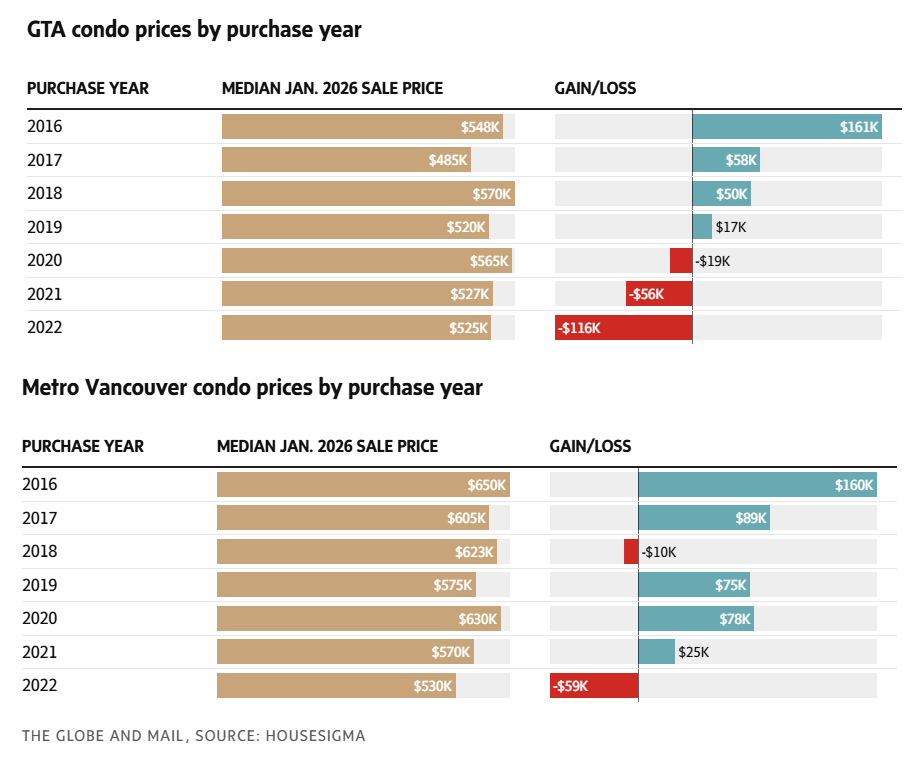
They bought their condos in the pandemic. Now, they’re stuck ‘bleeding cash.’ Mariya Postelnyak, Globe and Mail, February 16, 2026.
From a financial perspective, densification and more housing is win-win:
For renters and first-time homebuyers, apartments are less expensive, because there’s more of them.
For long-time homeowners, detached houses keep their value, because it’s mostly the land.
Even if you bought your first apartment recently and you’re watching prices drop, you should be okay as long as you don’t need to move. Why homeowners don’t feel rich (Glaeser and Gyourko, 2018):
... housing wealth is different from other forms of wealth because rising prices both increase the financial value of an asset and the cost of living. An infinitely lived homeowner who has no intention of moving and is not credit-constrained would be no better off if her home doubled in value and no worse off if her home value declined. The asset value increase exactly offsets the rising cost of living (Sinai and Souleles 2005). This logic explains why home-rich New Yorkers or Parisians may not feel privileged: if they want to continue living in their homes, sky-high housing values do them little good.
But if you do end up needing to move, and you’re underwater on your mortgage (owing more than the home is worth), you’re in a difficult situation. You need to somehow come up with enough money to cover the difference. Or you can hold on and rent it out, hoping for prices to recover.
From the Globe article:
An hour’s drive from downtown Toronto and just under 1,000 square feet, the two-bedroom condo was never meant to be home for long. It was a stepping stone into an overheated housing market for Francesca Parc and her partner.
In 2021, the long-time renters had suddenly found themselves with stable government jobs and qualifying for a $500,000 mortgage.
“Everyone around me was always saying, if you own a place, it’s an investment,” Ms. Parc, 36, said. “Why pay someone else’s mortgage?”
They thought they’d lucked out when their offer to buy a $520,000 two-bedroom condo was accepted. But five years later, Ms. Parc sees things differently. If the couple were to sell the condo today, they estimate they’d lose $70,000 to $100,000. Leasing would mean a $6,000 annual loss, based on the difference between what they could charge for rent and their mortgage payments plus condo fees.
Francesca Parc and her partner ended up moving into the city for a shorter commute, renting from her parents, and renting out the condo (taking a loss every month). This helps to explain why rents are declining: for an individual landlord trying to hang onto a condo, they don’t have the option of leaving it empty.
Buyer beware: owning your home gives you more security, but it means less flexibility.