Senakw: now renting
Getting international attention

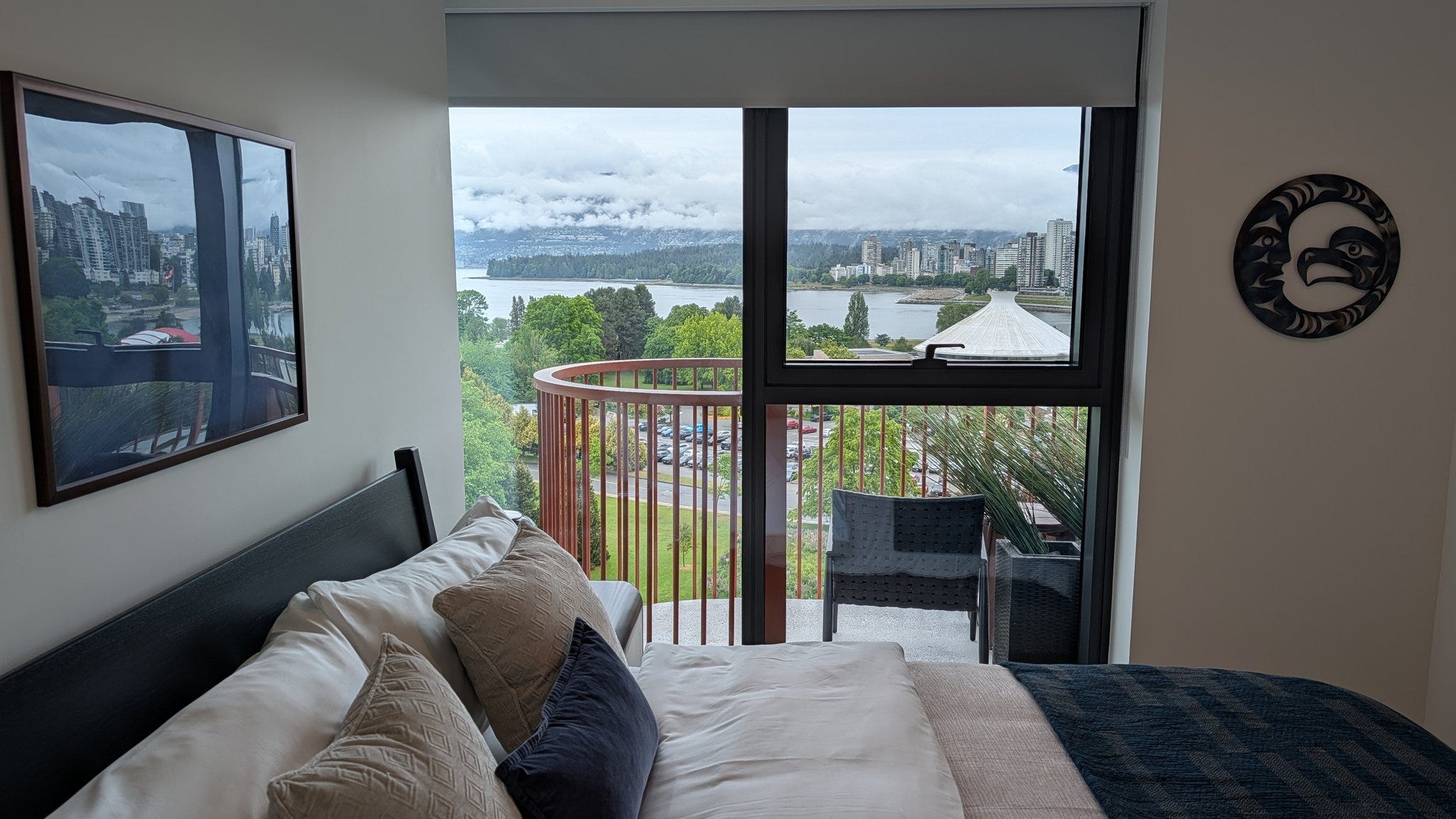
A look inside the rental homes of Senakw’s first completed tower, with tenants now moving in. Kenneth Chan, Daily Hive.
Inside Sen̓áḵw As Phase One Nears Completion. Howard Chai, The Realist.
See Vancouver’s Sen̓áḵw towers, from the inside out. Denise Ryan, Vancouver Sun.
New rental buildings in Vancouver mark fresh start for Squamish Nation – and might be what the market needs. Salmaan Farooqui, Globe and Mail.
The skyscrapers that NIMBYs and zoning couldn’t stop. Planet Money.
How the Squamish struck gold in Vancouver. Anya Martin, Works in Progress.
Salmaan Farooqui:
The project’s first three towers will add 1,400 rental units – more than half of the number of purpose-built rentals that hit the market in Vancouver in 2025. The site will eventually house 6,000 units.
Andrey Pavlov, a finance professor at Simon Fraser University, said Vancouver managed to add just 2,300 purpose-built rental units last year, which the city boasted as the highest in four decades.
It was “celebrated like a huge number” but was “absolutely nothing,” Mr. Pavlov said, noting Seattle once built just under 18,000 rental units in 2018 in comparison.
Senákw’s unsubsidized apartments will be more upmarket with modern finishings and amenities such as a gym, spa and pool. But Jenn Podmore Russell of Nch’kaý said the introduction of 6,000 rental units in the coming years will free up cheaper homes that might have been occupied by high-income renters because they didn’t have choices like Senákw.
Howard Chai provides the asking rents for the market rentals: about $5.50 per square foot, reflecting its location close to downtown.
Rents will start at $1,690 for studio units, $2,275 for one-bedroom units, and $3,505 for two-bedroom units.
Studio units will range from 310 to 375 sq. ft, one-bedroom units from 410 to 685 sq. ft, two-bedroom units from 625 to 850 sq. ft.
Anya Martin provides a good description of the status quo:
Despite this massive demand for housing, and its dense urban core, most of the city looks as it did decades ago. Vancouver pioneered single-family zoning in Canada: the municipality of Point Grey became the first in the country to adopt such rules in 1922. When Point Grey amalgamated with Vancouver in 1929, the principle spread citywide, although initially in a relatively permissive fashion. In the 1960s, the city briefly experimented with allowing apartment towers in residential areas, but a political backlash voted in a council in 1972 that was more resistant to development. From that point onwards, Vancouver systematically downzoned, restricting building heights and locking most of its land into low-density use. Today, 52 percent of Vancouver’s residential land supports just 15 percent of its homes.
Vancouver never managed to comprehensively reverse the downzoning of the early 1970s, despite the huge pressure on housing affordability since. But it did find a way to permit intensive development in narrow strips, typically along transport corridors, while leaving the suburban expanses largely untouched. The city is dependent on such developments: property taxes are low, so almost half of its C$3.5 billion capital budget comes from developer payments. Through a mixture of fixed development fees and Community Amenity Contributions, which are negotiated during spot rezoning on a case-by-case basis, planners extract funding for parks, childcare centers, and affordable housing units in exchange for permission to build. They aim to capture 75–80 percent of the land value uplift. Because each negotiation process can be lengthy, the city prefers to allocate a small number of highly valuable permits, creating an incentive structure that favors concentrated towers, rather than gentle density across the city.
Previously: