RBC's June 2026 housing affordability report
Metro Vancouver: still the worst in the country

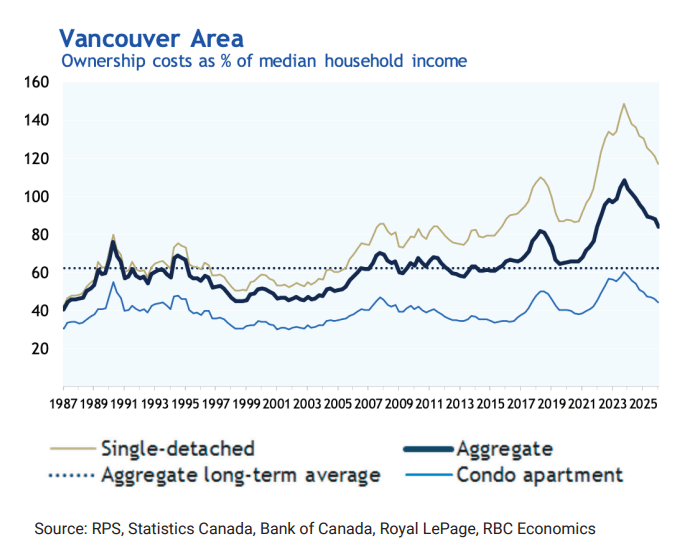
Improving housing affordability continues in most Canadian major markets. Robert Hogue and Rachel Battaglia, RBC Economics, June 2026.
RBC releases a housing affordability report every quarter, comparing home ownership costs to median household pre-tax incomes.
From the latest report:
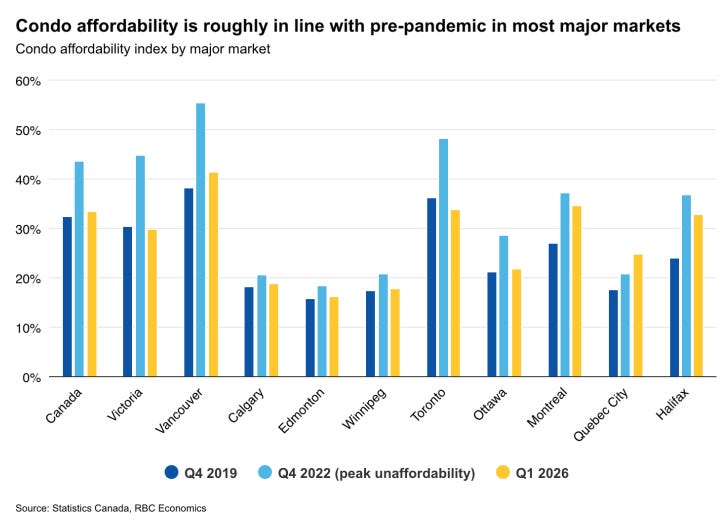
Homeownership has been improving in Canada since early 2024 — particularly for condos.
Price corrections have been sharper than other housing types, helping restore affordability back to 2019 levels in many markets. RBC’s national condo affordability measure is 35.2%, less than a ppt from Q4 2019. Some markets have even improved from pre-pandemic conditions. Toronto now sits at 36.1% (down from 38.5% in Q4 2019) and Victoria at 31.8% (versus 32.2% in Q4 2019).
Though relief has been widespread, there are still markets where condo affordability remains meaningfully elevated from pre-pandemic norms.
Tight supply and the earlier population boom have contributed to an aggressive lift in condo prices in Montreal, Quebec City and Halifax, which have yet to come down meaningfully.
There’s a graph showing condo affordability. The Vancouver metro area is back down to only slightly above 2019 levels, but still the worst in the country. Getting from above 40% down to Edmonton levels (below 20%) may not be realistic, but even Victoria is closer to 30%.
Metro Vancouver has limited land, but there’s nothing physically stopping us from building more apartments. They should be like cars: if we need more, we can build more.
RBC’s calculation of home ownership costs includes:
Mortgage payments (principal and interest), assuming a 20% down payment, a 25-year amortization, and a five-year term with a fixed interest rate
Property taxes
Utilities
For condos, it doesn’t include strata fees.
Reddit thread. Someone commented:
Condos are by no means sustainable housing for a family of 3.
My response:
I’m in Vancouver, where land is particularly limited (because of the ocean and the mountains), so we’re getting a lot of apartments. I’m very interested in the question of how livable these apartments will be.
In Montreal, you see a lot of three- and four-storey apartment buildings with a single family-sized flat per floor. Family-sized flats also seem pretty common in Europe. Middle-class flats in Europe.
A big problem in Vancouver is that costs per square foot are very high, and so you get shrinkflation. To get larger apartments, we need to bring down these costs. (For example, it takes a long time to get anything approved, which is costly; speeding up approvals will reduce costs. Allowing more height will reduce the cost of land per square foot of floor space.)
Elsewhere I mentioned that I’d like to get back to 2003-2004 levels of affordability. Someone else commented:
I want houses to be $1 but it’s no possible. If you want houses to roll back to 2003-2004 levels then what’s your plan?
I’m in Vancouver. In Metro Vancouver and the GTA, there’s three levers that municipal governments have been using to increase housing prices:
Development charges. These are up-front one-time taxes on new housing. In Metro Vancouver and the GTA, but not the rest of the country, these are extremely high (more than $100,000 per apartment in the city of Vancouver). Basically, municipalities in the Vancouver and Toronto metro areas have been ratcheting up the price of housing by maximizing the revenue they can extract from new housing. This affects existing housing as well as new housing, since they compete with each other.
Approval processes. These are extremely slow and labour-intensive, with a level of micromanagement amounting to co-design. See Larry Beasley’s book Vancouverism for a good explanation.
Land costs. Land in Metro Vancouver is limited by the ocean and the mountains, and therefore expensive. By restricting height and floor space, municipal governments are able to raise the cost of land per square foot of floor space.
The problem is, because municipal governments in Metro Vancouver and the GTA are relying on development charges, their incentives are exactly backwards, as pointed out by the recent MacPhail Report. When housing is expensive, they’re able to extract a lot of revenue from first-time homebuyers and from renters, in the form of development charges. When housing is less expensive (as has been happening recently), it’s a financial disaster for them.
Mario Polese compares this dependence on development charges to going through a trap door. Once you’ve gone through, it’s very hard to get back out.
For municipalities like Edmonton or Moncton which encourage housing, new housing is a good thing. Besides providing construction jobs, it generates a steady stream of future property-tax revenue.
In contrast, Vancouver’s strategy since the 1980s has basically been the same as OPEC’s: selling permission to build in limited quantities, at high prices.
The federal and provincial governments (in Ontario and BC) are attempting to break this municipal addiction by putting a lot of money on the table to pay for municipal infrastructure (via the “Build Communities Strong” fund), in exchange for municipalities cutting their development charges on new housing. That’s the reason for the recent agreements between Canada and Ontario, and between Canada and BC.
How much difference can this make? Check out this pre-Covid CMHC analysis of the gap between construction costs and prices to add one more floor to an apartment building, reflecting municipal restrictions. In Montreal, there’s no gap. In the Vancouver and Toronto metro areas, there’s a giant gap. In Vancouver, it’s about a third.
So government shouldn’t charge development charges? That’s your solution?
There’s three levers.
One is cutting development charges.
A second is reducing the time it takes to navigate the agonizingly slow approval process. (In Edmonton, it’s possible to acquire land and deliver housing in the same calendar year. In Vancouver, a retiree spent eight years fighting city hall to build a six-storey rental building with 35 apartments.)
A third is reducing the cost of land per square foot of floor space, by allowing more height and more floor space.
And why shouldn’t the government charge development charges?
How much time do you have?
Benjamin Dachis has been talking about this for years. August 2018: Hosing Homebuyers: Why Cities Should Not Pay For Water and Wastewater Infrastructure with Development Charges. “Municipalities should eliminate DCs for water and wastewater and instead levy full-cost user fees that cover the full cost of amortized capital (as argued by Clayton 2014). This is the pricing model that private and municipally owned utilities in the natural gas and electricity market have used for decades without relying on up-front fees.”
A more recent version, November 2024: Want to lower both housing costs and emissions? It’s time to embrace utility financing of infrastructure.
Some points:
Costs act as a floor on prices and rents. In the longer term, if we want to keep pushing down prices, we need to figure out how to lower costs.
It makes more sense to have municipalities pay for capital investments up front by borrowing (issuing long-term bonds) and then paying them down over time with revenue from water charges, instead of having homebuyers pay for them up front by taking on larger mortgages. Homebuyers have to pay significantly higher interest rates, since the lender’s taking on more risk.
From the perspective of municipal governments, it’s a “leaky bucket.” They collect revenue from new housing. But this also raises the price of existing housing (since they compete with each other), and they don’t get any of that benefit - it goes to private homeowners.
In the current financing model, water charges just pay for day-to-day operational expenses, not long-term capital expenses. Lower prices result in higher water usage. (Some municipalities, like the city of Vancouver, don’t even have universal water metering - it’s a fixed charge for all-you-can-eat.)
More
Housing affordability improves, but RBC says relief may be running its course. Canadian Mortgage Trends, July 2026.
Previous posts including RBC’s housing affordability graph: June 2025, June 2024, March 2023.
And yet, they complain that now they can't build, must stop building.
I just had "housing trap" explained the other day. Not the concept, painfully familiar; but it's a great turn of phrase.
We need pols to start using the term "housing trap", to signal they admit we can't free-market-subsidize our way out of this.