Ontario and federal government reach agreement to cut development charges
With HST cut, reduces costs by up to $200,000 per new home


In Metro Vancouver and the GTA, there’s two major barriers to new housing:
The approval bottleneck. Getting approval to build new housing is slow and difficult, and delays increase the cost of new housing.
The cost bottleneck. Even if something is legal to build, when costs are too high it won’t get built. Declining prices, in combination with high development charges in Metro Vancouver and the GTA, have been pushing more and more projects underwater.
High development charges are primarily a problem in Metro Vancouver and the GTA:
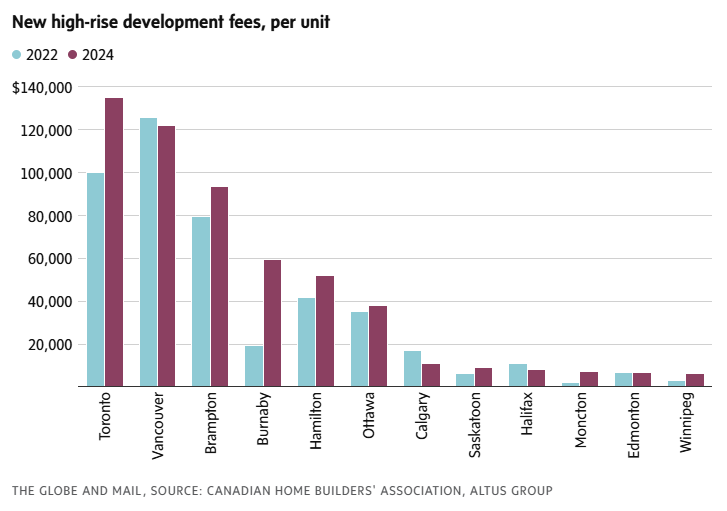
Mario Polèse describes the municipal decision to tax new housing heavily as a “fiscal trap door”: once you go through, it’s very hard to get out.
The 2025 federal budget included $12 billion over 10 years for a Build Communities Strong fund, to fund municipal infrastructure. The conditions on the fund:
To access funds, provinces and territories must agree to cost-match federal funding and to substantially reduce development charges and not levy other taxes that hinder the housing supply.
On Monday, the federal and Ontario governments announced that they’ve reached an agreement to cut development charges significantly (the headline was “in half”). Federal, Ontario governments to spend $8.8-billion to cut municipal development charges. Rachelle Younglai, Laura Stone, and Jason Kirby, Globe and Mail.
The federal government and Ontario will invest $8.8-billion in infrastructure over the next decade in a bid to encourage the province’s municipalities to reduce real estate development charges, offering another boost to home builders at a time when new home sales across the country have plunged.
Combined with a measure announced last week to rebate the harmonized sales tax on new homes in the province, the two governments now project the taxpayer funds will cut up to $200,000 in taxes and fees for a new home in Ontario, marking the latest incentive designed to revive the home building market.
The governments said the $8.8-billion in infrastructure investment will be provided over 10 years and that municipalities that receive it will be required to cut development charges, also known as DCs, for three years.
Negotiations between the federal and provincial governments have been going on for a while, and I’m very curious how negotiations with BC are going. From December 2025:
Skeptics might wonder whether this won’t just result in higher profits. The answer is that competition is how lower costs result in lower prices. In a competitive market, suppliers have a strong incentive to lower their prices so that they don’t get stuck with unsold inventory.
The housing market is very competitive. Unlike airlines, or banking, or telecom, there’s innumerable suppliers competing with each other. That’s why suppliers are currently going bankrupt rather than somehow collaborating with each other to prop up prices.