Image of the day: New Zealand economists on land-use restrictions and housing affordability
Prices reflect scarcity

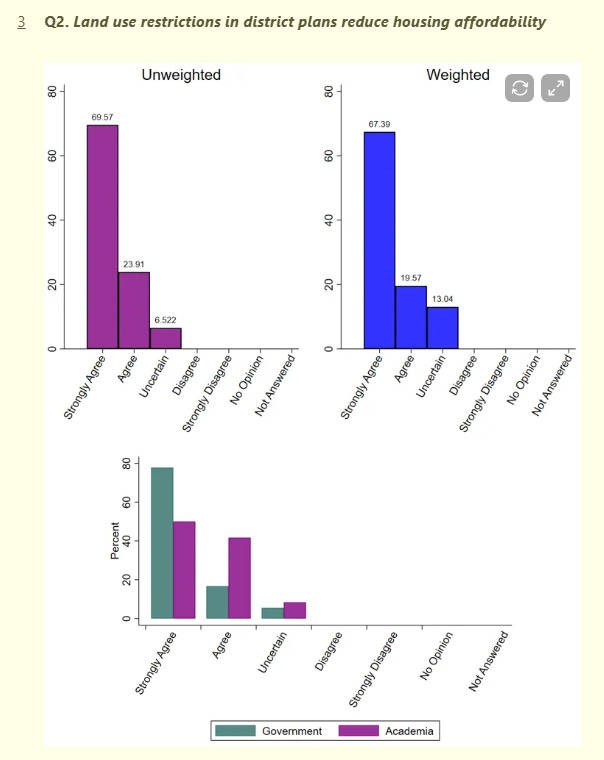
Land-use restrictions & housing affordability. Dennis Wesselbaum, February 2024. Describes the results of a survey of members of the New Zealand Association of Economists.
Q1. Do land-use restrictions in district plans reduce housing supply? (Yes)
Q2. Do land-use restrictions in district plans reduce housing affordability? (Yes)
Q3. Will easing restrictions in district plans tend to increase housing supply and affordability? (Yes)
Overall, there appears to be a strong consensus among economists, as represented by NZAE members responding to this survey.
Land-use restrictions reduce both housing supply and housing affordability.
Easing such restrictions would improve these two dimensions of the housing market.
The survey was prompted by the report of the Independent Hearings Panel on the Wellington District Plan, which was skeptical that more supply would help with affordability.
More:
Wellington’s housing panel is out of step with the economic evidence. Stu Donovan, February 2024.
Decisions on Wellington City Council’s District Plan. Chris Bishop (minister for RMA reform), May 2024. Basically took the side of the city council (to allow more density) rather than the panel.
The housing economist (Stu Donovan) who tested the rental market — and watched it prove him right. Deborah Morris, the Post, January 2026. Reddit thread.
What makes the New Zealand data useful isn't just the consensus — 90%+ of economists agreeing that land use restrictions reduce affordability is about as close to unanimity as you get in economics — it's the Wellington case study that followed. You had a hearings panel actively skeptical that supply would help affordability, the economic profession pushing back with survey evidence, and then the government siding with density over the panel. That's the rare sequence where the research actually changed the policy outcome. The part that translates globally is the gap between what economists broadly agree on and what local planning bodies actually implement. In the U.S., I track 392 metros and the pattern is almost identical — the markets with the most restrictive zoning consistently show the widest affordability gaps, and the local decision-makers in those markets are usually the last to accept that their own land use framework is the primary driver. The survey result that deserves more attention is the bottom chart: government respondents and academics both overwhelmingly agree, which means the disconnect isn't between researchers and policymakers at the national level — it's between national consensus and local implementation. For those following housing policy in other countries, are you seeing the same dynamic where local planning bodies resist supply-side evidence even when national-level economists and legislators have moved on?