Spot rezonings consistent with the overall Official Development Plan no longer require a public hearing
An example from yesterday

Council agenda, April 14, 2026.
Staff report for CD-1 Rezoning: 4088 Granville Street. This was item 12 on the agenda.
Video from the council meeting.
Now that the city of Vancouver has approved its overall Official Development Plan, spot rezonings which are consistent with the ODP no longer need to go through a public hearing.
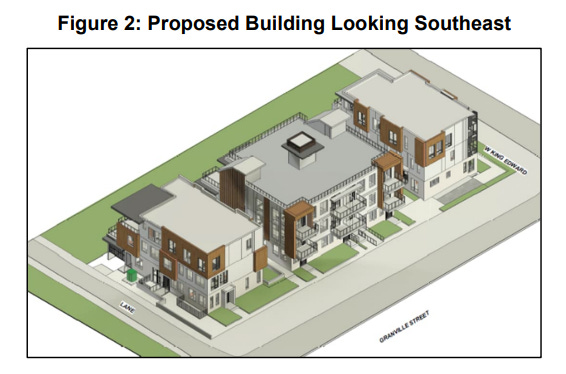
The rezoning application for 4088 Granville Street is to allow three small purpose-built apartment buildings, with a total of 30 homes, to be built on a single large lot at King Edward and Granville, which currently has a single-detached house. Previously it would have required a public hearing with an unlimited number of speakers. This time council passed it unanimously, as part of the “consent agenda” (items passed by unanimous consent).
This is an excellent example of how provincial legislation can reduce approval delays and thus costs. BC has updated the Vancouver Charter and the Local Government Act to say that a spot rezoning which is consistent with the municipality’s Official Community Plan (or ODP in Vancouver) no longer needs to go through a public hearing.
As the MacPhail Report puts it:
We recommend a stronger role for housing needs estimates and citywide official plans, which guide how entire communities are expected to grow. We also recommend reduced reliance on site-by-site public hearings and council approvals that delay homebuilding and amplify the voices of groups opposing new housing at the expense of citywide objectives and affordability.
If we’re going to have a battle over the city’s growth, the time to have it is when we’re deciding on the city-wide plan. We don’t need to re-litigate it with an unlimited number of speakers on each and every subsequent rezoning.
Previously:
The consent agenda mechanism means that the school capacity, infrastructure, and amenity questions The Visual Thinking Company (VTCo) identified as unreconciled at the ODP level now do not get examined at the project level either. At the project level, those questions could theoretically have been raised by speakers, by staff, or by Council.
Under the prior public hearing regime, the Sir Sandford Fleming precedent — where enrollment divergence was documented and put on the public record — was only possible because there was a public hearing. The consent agenda route forecloses that.
https://cityhallwatch.wordpress.com/2026/03/06/stealth-changes-vancouver-risk-school-liquidation-cheng/
30 units at one site is immaterial in isolation. The question is what happens when dozens of consent-agenda rezonings accumulate in a single school catchment over 18-24 months, none of which individually triggers a capital planning review, but which collectively produce a enrollment pressure the VSB's Baragar model cannot see because it only tracks enrolled students, not authorized future residents. To add insult, the VSB is only planning for 76 of 100 future kids.
VTCo documented this exact dynamic in its Gap 2: no binding school capital trigger exists in the ODP. The 4088 Granville approval is an observable instance of that gap operating in practice. It is not evidence of a problem yet. It is the mechanism by which the problem will accumulate.
https://council.vancouver.ca/20260310/documents/phea1other20260310_Dist4_4to7pm_Redacted.pdf