New Urbanists and YIMBYs
"Quality" vs. "supply"


When New Urbanists and YIMBY’s fight. Seth Zeren, November 2023.
An interesting post talking about the difference between New Urbanism (an urban design movement going back to the 1980s, focused on walkability and public spaces) and the YIMBY movement. There’s a fair amount of overlap, but the people involved tend to have somewhat different motivations.
New Urbanism was populated firstly by architects who wanted to build another way, then planners who sought better objectives for planning and new tools to regulate development. Many of the iconic projects of early new Urbanism, from Seaside to Kentlands were economically successful market-rate development projects and there has long been an orientation of new urbanists toward developers and popular taste.
Because new urbanists want to build, the bulk of practicing new urbanists are based or work substantially in the US south and midwest, and in suburban and exurban areas, where regulations and economics have been more favorable for building.
New Urbanists have worked on policy reforms over the decades, but generally these reforms are technical, including subtle reforms to mortgage standards or shifting zoning toward more mixed-use and form considerations. So to greatly oversimplify, new urbanism is a movement tilted toward older urban designers and southerners (as Steve Mouzon is) working against status quo suburban development to build better places, i.e. “quality.”
In contrast, the YIMBY movement is primarily driven by people in places like San Francisco who are frustrated with inability to build, period.
The YIMBY movement at its core was driven by activists (not architects or professionals) focused on political power building and policy change, drawing on economists (housing papers) and lawyers (the color of law) for intellectual grounding (rather than historical architecture and urban design, as for New Urbanists). YIMBY’s have forged alliances with tenant-rights organizations and unions to win major state-wide legislative victories.
The YIMBY’s are most active and fired up in regions with severe housing crises, such as California, Washington, Oregon, New York, Washington DC, Massachusetts etc. As the housing crisis has metastasized nationwide over the past several years, the YIMBY banner is being picked up in many states, cities, and regions, each with its own local flavor but united by the desire to build.
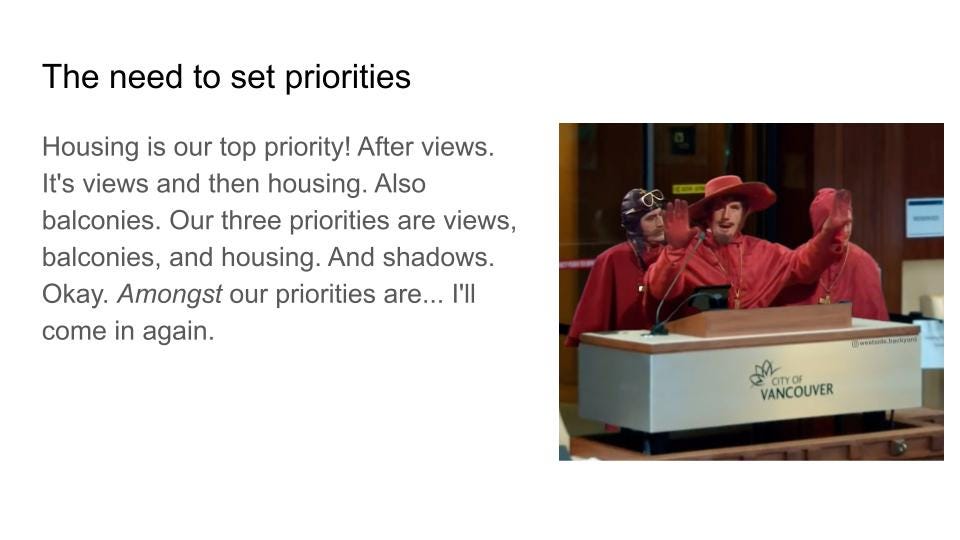
In Vancouver, our institutions have emphasized urban design for several decades without much regard for cost, resulting in a city that’s very pretty and very expensive. My own view of urban design is that it has costs as well as benefits, and that we need to set priorities instead of always putting housing at the bottom of the list.
Great read! It’s nice to more authers writing about the cities and urban planning. I do the same. Please check one of the recent posts on Suburbia and new waves of promoting micromobility in cities:
https://open.substack.com/pub/nogoplus/p/why-north-american-cities-became?r=6cyw21&utm_campaign=post&utm_medium=web&showWelcomeOnShare=false
Thank you for sharing that article. I think about this a lot. What I have observed is New Urbanists also tend to favour megaprojects instead of incremental change, which as a Strong Towns advocate can be very frustrating. Like that article talks about I have seen first hand how a self proclaimed urbanist will fall into the trap of prioritizing beautiful and shiny over functionality and cost.
What is often overlooked is that most of the places with "good urbanism" that were built and planned from nothing usually had some form of subsidy - either cheap land, expert facilitation offered at no cost, cashing out equity from land banking, discounted property taxes (e.g. TIF) or fees, or actual government subsidy to build them out and plan them. This is the reason why New Urbanist developments have failed to become the status quo, incentives to go from zero to livable density have to be fabricated and coordinated, so they remain scarce instead of abundant.