National unity and the housing shortage
In dealing with Trump 2.0, maintaining Canada's national unity is paramount

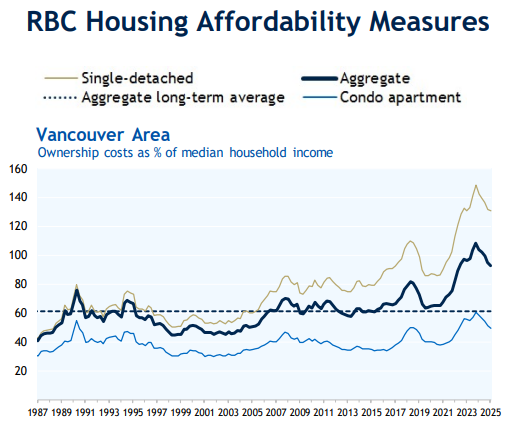
The chronic housing shortage in Metro Vancouver and the GTA has resulted in a great deal of conflict and tension within Canadian society, particularly along generational lines between older homeowners on the one hand, and younger renters and first-time homebuyers on the other hand.
Matthew Holehouse, writing in July 2025 about weak economic growth in the UK, observes that the incentives of older voters are different from those of younger voters.
The paper argues that the overrepresentation in the electoral system of older voters is skewing the incentives on economic policy. Increasing the turnout of younger, poorer and more insecure voters by mandatory voting would “make it harder for politicians to allow stagnation, and easier for them to pursue growth”.
The argument in the paper is not that older people are somehow selfish, or indifferent to the country’s well-being. Rather it is simply that their role in the economy—out of the labour market, often having accumulated property, and with reliable pension incomes—makes them, as a cohort, less sensitive to economic downturns, less invested in wage growth and much more exposed to inflation than working-age voters. The result is a “post-economic voting block” which is less likely to reward governments that pursue productivity boosters (such as building houses and infrastructure, or promoting education and trade liberalisation) and less inclined to punish those that oversee weak growth.
Right now, this generational divide is particularly critical because Trump 2.0 is an ongoing foreign-policy crisis for Canada. Even if Trump has said that he’s planning to use economic coercion (“economic force”) against Canada, rather than military force, it’s still a dangerous situation for Canada, with a range of possible outcomes that’s far wider than usual.
And the most important principle of Canadian foreign policy is to maintain our national unity. Louis St. Laurent, 1947:
The first general principle upon which I think we are agreed is that our external policies shall not destroy our unity. No policy can be regarded as wise which divides the people whose effort and resources must put it into effect. This consideration applies not only to the two main cultural groups in our country. It applies equally to sectionalism of any kind.
We dare not fashion a policy which is based on the particular interests of any economic group, of any class or of any section in this country. We must be on guard especially against the claims of extravagant regionalism no matter where they have their origin. Our history has shown this to be a consideration in our external policy of which we, more even than others, must be perpetually conscious. The role of this country in world affairs will prosper only as we maintain this principle, for a disunited Canada will be a powerless one.
When we’re making decisions on housing policy, or even on individual projects, we always need to keep the big picture in mind. We live in a society. We’re in a critical time, when we need solidarity between older Canadians and younger Canadians.
I’m not saying this to be critical of older people. It’s natural to be concerned about change to your neighbourhood. Brynn Lackie, writing in the Toronto Sun in 2022:
I regularly rail against NIMBYism in these columns, but when we recently learned that the Starbucks at my corner will be giving way to a new 11-story building, my immediate reaction was frustration and dread.
I thought of what a drag it will be to live through the construction, how street parking will get even harder to come by, what an adjustment it will be to have all those new neighbours staring down into my backyard. I even caught myself saying, out loud, to human people that could actually hear me, that the light will change in my backyard and our trees will probably die.
Turns out that I am that NIMBY I love to disparage so much!
But in the current crisis, we need to stay focused on the big picture. It’s not just separatism in Alberta or in Quebec that Trump can use as a wedge against Canada. If our goal is to defend Canadian society, we also need to make sure that Canadian society takes into account the interests of younger people.
Trump and Wilhelm II
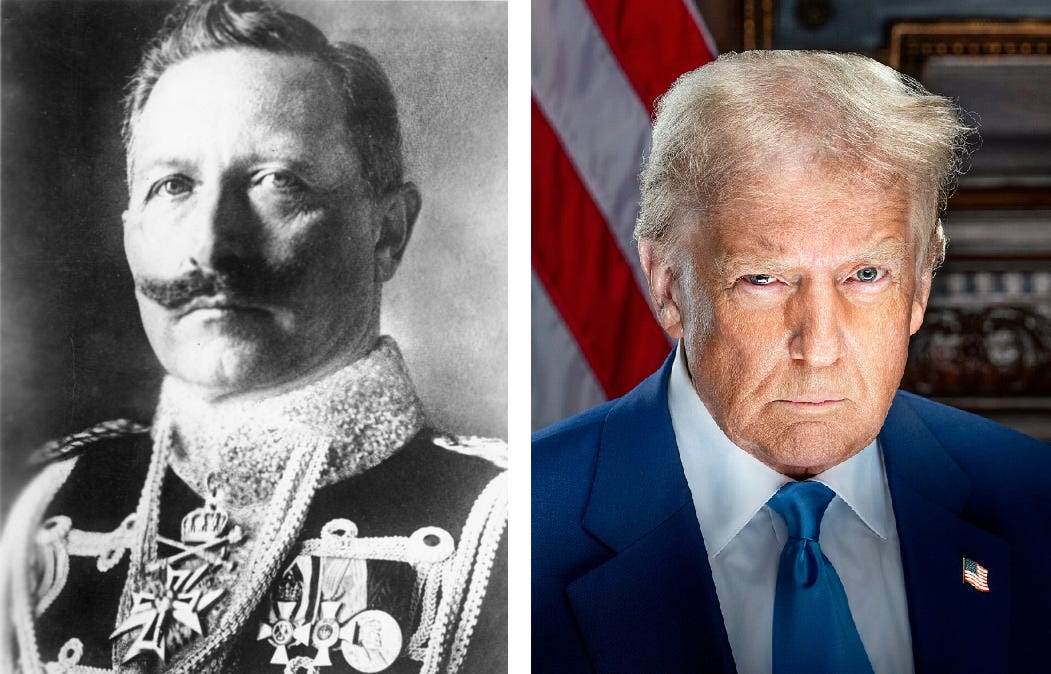
One of the reasons it’s difficult to deal with Trump is that it’s hard to take him seriously.
One historical analogy is Wilhelm II, who ended up leading Germany into World War I. Wikipedia quotes Thomas Nipperdey, who describes him as
...gifted, with a quick understanding, sometimes brilliant, with a taste for the modern,—technology, industry, science—but at the same time superficial, hasty, restless, unable to relax, without any deeper level of seriousness, without any desire for hard work or drive to see things through to the end, without any sense of sobriety, for balance and boundaries, or even for reality and real problems, uncontrollable and scarcely capable of learning from experience, desperate for applause and success,—as Bismarck said early on in his life, he wanted every day to be his birthday—romantic, sentimental and theatrical, unsure and arrogant, with an immeasurably exaggerated self-confidence and desire to show off.
After the 19th-century unification of Germany, Bismarck sought to keep Germany from being encircled by hostile powers. But after Wilhelm II became ruler of Germany, he simply lacked the ability to understand Bismarck’s careful diplomacy. He discarded it to pursue Germany’s “place in the sun,” with incalculable consequences.
Hans Morgenthau, writing during the early Cold War:
A nation that throws into the scale of international politics the maximum of material power it is capable of mustering will find itself confronted with the maximum effort of all its competitors to equal or surpass its power. It will find that it has no friends, but only vassals and enemies.
After World War II, the US established institutions and backed international law, as a form of self-restraint. The US under Trump has now abandoned this self-restraint. As Ezra Klein puts it, those around Trump talk about making full use of the “leverage” that the US has.
After the last three weeks, we’re in a new world now. Venezuela, and the continuing crisis over Greenland, make that clear. Whenever there’s a relaxation of tension, it’s natural to hope that we’re out of the woods. But that’s not what’s happening. If anything, it’s the opposite: we’re heading deeper into the woods.
More
Ivan Krastev, April 2025, on Trump 2.0 as a revolutionary government.
Alex Muir describes the factions in Trump’s court. What the various factions of MAGA think about Canada (if anything), April 2025.
Joseph Heath describes populism as a rebellion against the cognitive demands of modern society. Populism fast and slow, October 2025.
Mark Carney’s speech at Davos last week, on the nature of the world that we’re now in, and the need for the middle powers to continue to work together. “A world of fortresses will be poorer, more fragile, and less sustainable.”