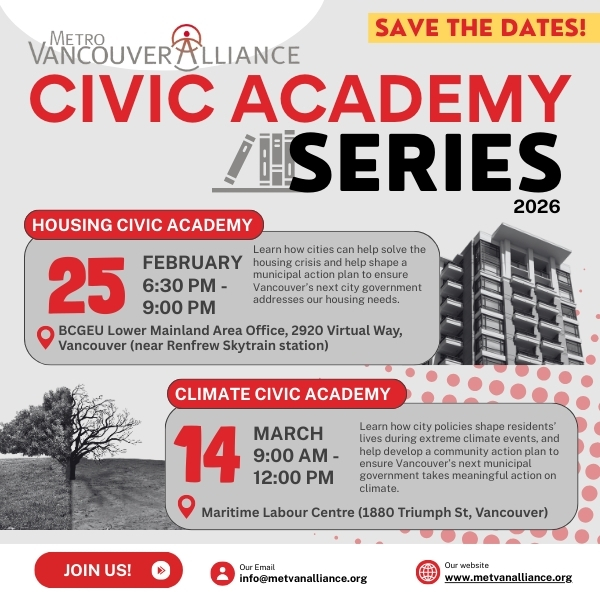
Presentation for the Metro Vancouver Alliance

The Metro Vancouver Alliance held an educational event on housing yesterday (“Housing Civic Academy”). I gave a short presentation.
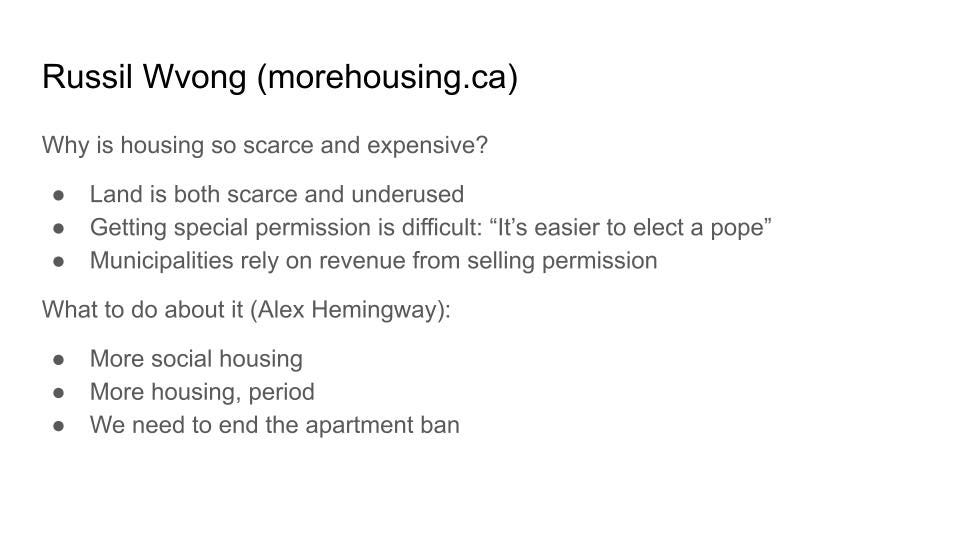
My name’s Russil Wvong. I’m part of the local pro-housing crowd. There’s a lot of younger people and renters who are frustrated at how scarce and expensive housing is in Vancouver. Because we don’t have enough housing, prices and rents have to rise to unbearable levels to keep people out, and to force people to leave. This also means that the healthcare system is under increasing strain, because it’s hard to hire nurses when younger people can’t afford to live here.
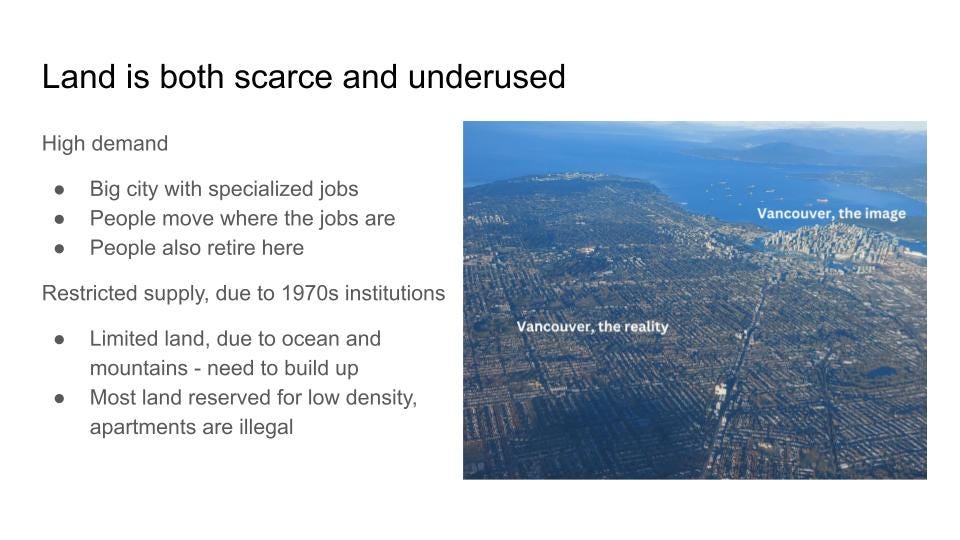
Lots of people want to live and work here, or retire here. So demand is high. At the same time, we have limited land, because of the ocean and the mountains. In order to grow, as people retire and other people need to move here to fill those jobs, we need to build up.
But as you can see, Vancouver looks like an island of high-rises surrounded by a sea of low-density housing. The reason is that apartment buildings are illegal on almost all of the land. As recently as 2018, it was illegal to build a duplex. The only thing you could do was tear down an old single-family house and put up a new maxed-out single-family house.
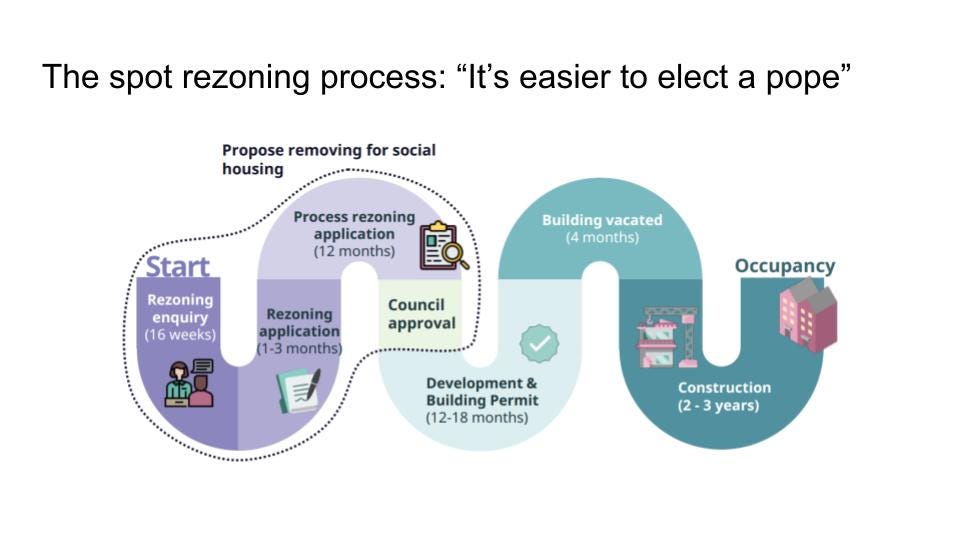
If you want to build an apartment building, you have to go through an extremely slow and difficult process called spot rezoning, which basically means changing the city’s laws for your one particular site.
What’s shown here is the best-case scenario. There was a retiree named Peter Miller who wanted to replace three old duplexes in Kits, built in 1943, with a six-storey rental building. It took eight years of fighting with city hall, and there were 35 people who spoke in opposition. He did get the approval in the end, but unfortunately he died at the age of 85, before construction could start.
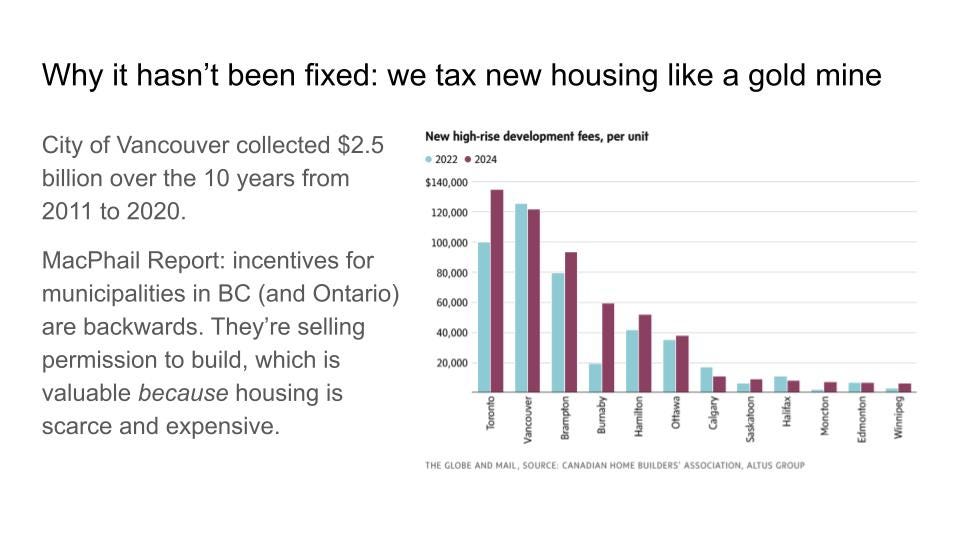
When I first saw a public hearing, years ago, I thought, why is this process so broken, and why hasn’t anyone fixed it yet? The answer is, money. Vancouver and other municipalities in BC and Ontario are able to tax new housing like it’s a gold mine. They’re basically selling permission to build. And because housing is so scarce and expensive, they’re able to charge a lot. That means their incentives are backwards.
As part of the rezoning process, you have to pay supposedly-voluntary Community Amenity Contributions. They’re worth a lot. Over 10 years, the city collected $2.5 billion dollars in CACs. The city’s been maximizing revenue from new housing, and thus jacking up rents and prices. They’re basically sticking renters and first-time homebuyers with as much of the bill as possible.
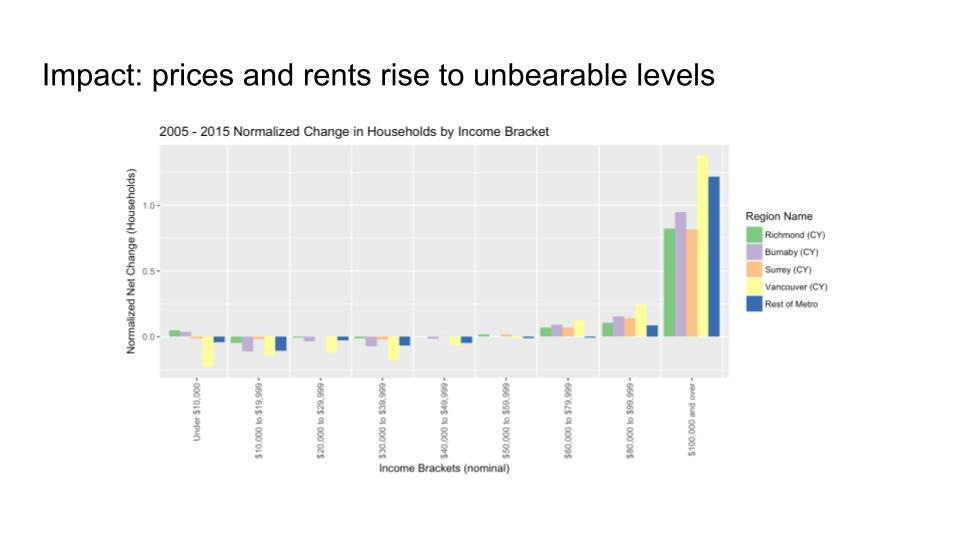
The housing shortage means that prices and rents act as a barrier. They have to rise to unbearable levels. This forces people to move away, to crowd into whatever housing they can find, or worst of all, end up homeless.
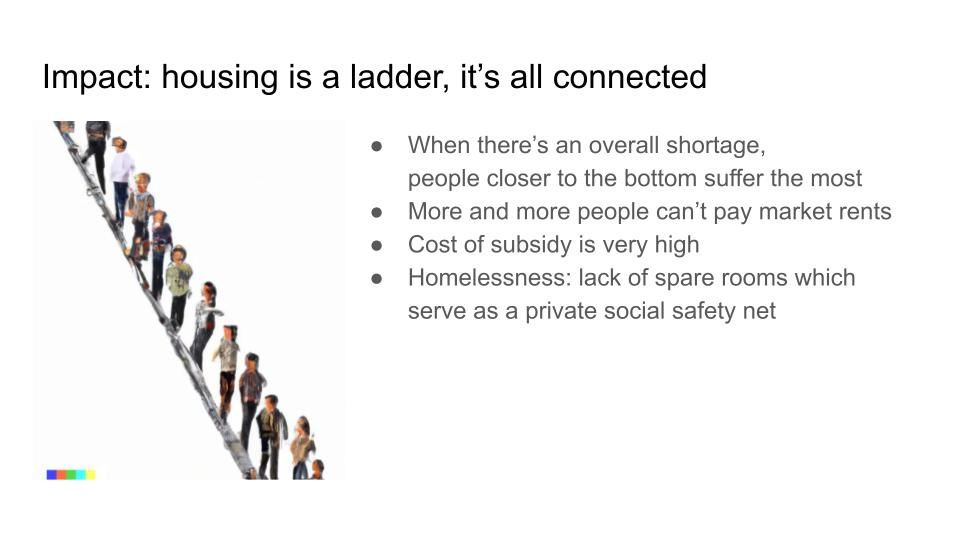
Housing is a ladder. It’s all connected. When opponents block new housing from being built, the people who would have lived there don’t vanish into thin air. They move down the housing ladder, finding somewhere that’s smaller, or older, or further out. And then you get trickle-down evictions, as other people who are looking for a place are forced to do the same thing.
For people near the bottom of the ladder, they don’t have anywhere to go. In a less expensive city, people have spare rooms that serve as a kind of private social safety net. They can offer a spare room to friends and family who are having a tough time. In Vancouver, when you’re already living with roommates, you don’t have that space to offer. So scarce and expensive housing results in homelessness.
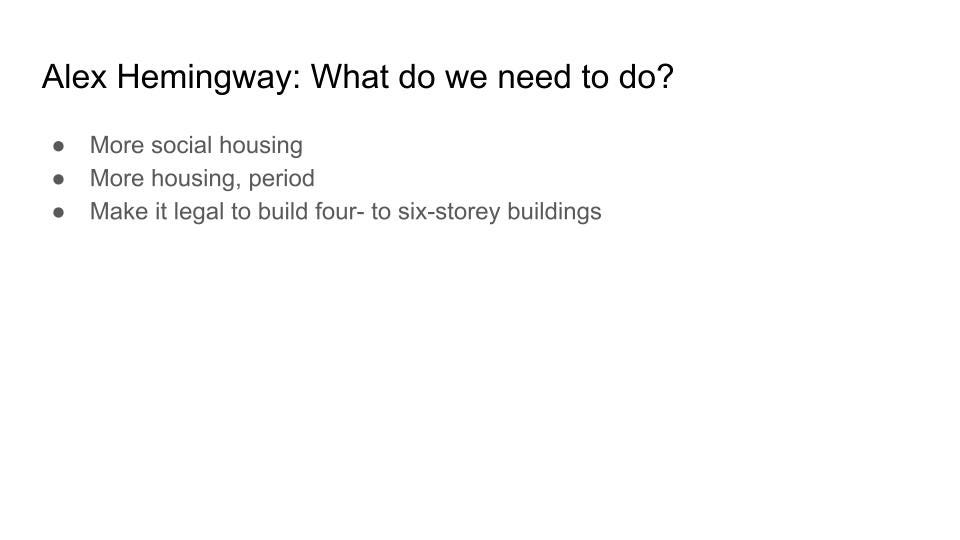
So that’s the current situation. What do we need to do to fix it? Alex Hemingway wrote a great article recently on this subject. We need more social housing. We need more housing, period. And we need to make it legal to build apartment buildings.
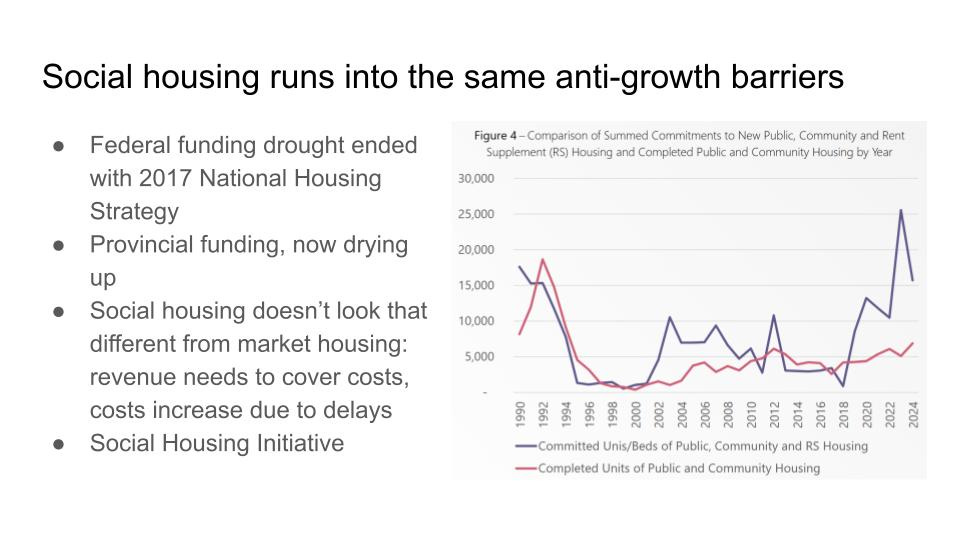
During the 1980s and especially the 1990s, government funding for social housing completely dried up. Starting around 2017, there’s been more federal funding for social housing, and there’s also been provincial funding. (Although that’s now drying up as well.) But a social housing project doesn’t actually look that different from market housing. The stream of future rental revenue has to cover the cost of construction. And social housing runs into all the same delays that market housing runs into, which result in higher costs and rents.
Vancouver city council launched something called the Social Housing Initiative three years ago, to make it easier to build social housing. It would have made it legal by right to build social housing, without having to go through a spot rezoning.
William Azaroff of Brightside Community Homes gives an example. They were building a six-storey social housing project in Marpole. Six storeys is allowed, but the property was on a hill, so one side of the building was 1.5 metres too high to be allowed under the zoning. So that meant a rezoning and a full public hearing. Interest rates and construction costs were going up over the eight or ten months, so that added $4 million to the cost of the project, resulting in higher rents.
Unfortunately, after three years of work and public consultation by city staff on the Social Housing Initiative, ABC hesitated and decided not to go ahead with it. So reviving it would be one obvious move. William Azaroff is now running for mayor, and he’s said that passing it would be one of the first things he’d do.
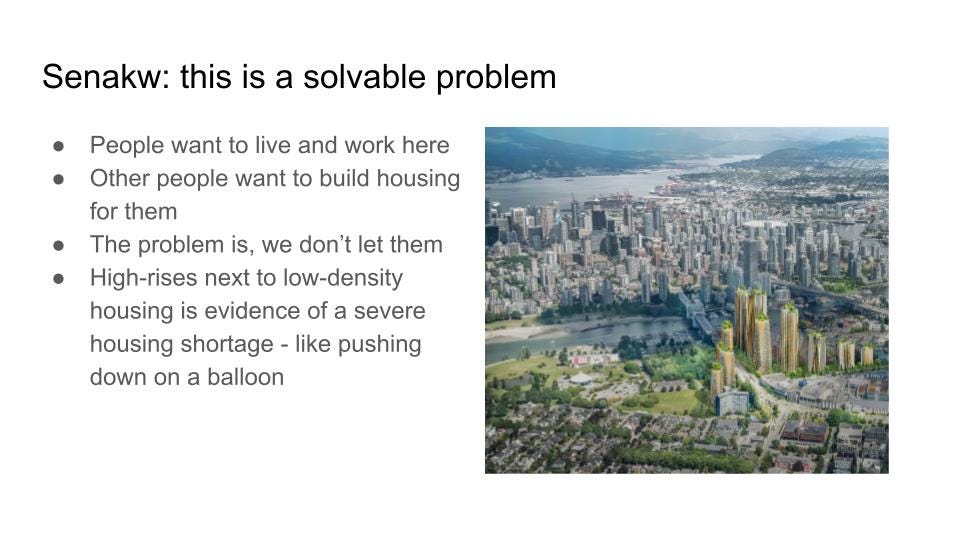
Besides more social housing, we need more housing, period. The Senakw project is a good illustration of just how restrictive Vancouver’s bylaws are. The site is a relatively small parcel of Squamish reserve land, so the city’s bylaws don’t apply. Turns out that without those restrictions, there’s a lot of people who want to live pretty close to downtown. So the project is building 6000 rental apartments, 1200 below-market, in the form of high-rises up to 60 storeys tall. Meanwhile just down the street, there’s an old two-storey, eight-unit rental building, built back in 1972. It’s illegal to replace it with a new building of the same size. Instead the owner applied to replace it with three super-expensive single-family houses.
Whenever there’s high-rises going up right next door to low-rise housing, it’s a sign that there’s an extremely severe housing shortage. Normally what you’d expect to see is more gradual redevelopment for greater height. But Vancouver’s zoning restrictions are like pushing down on a balloon. Whenever more height is allowed in just one spot, that means people will build as high as they can.
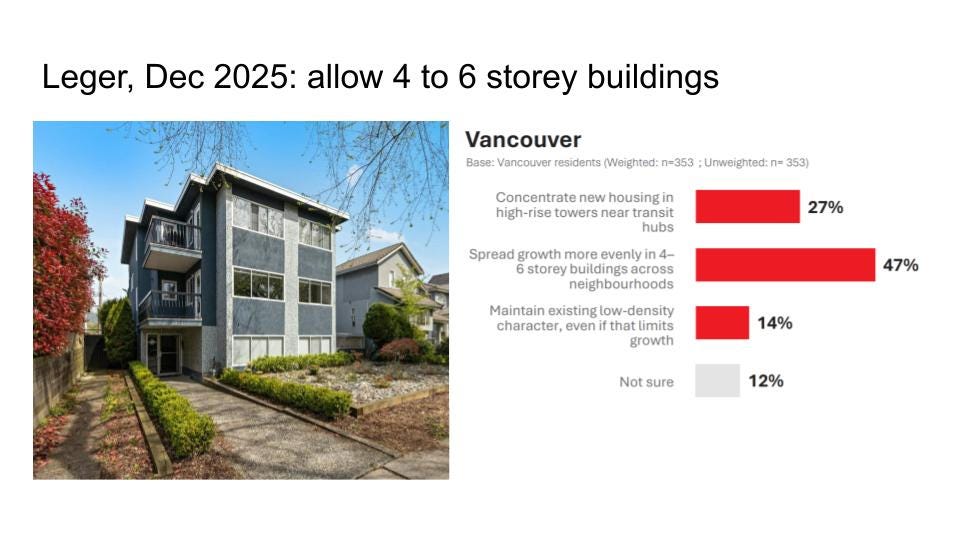
An alternative to building high-rises in a relatively small area is to allow four to six-storey buildings everywhere. There was a poll in December that found this was the most popular way to provide new housing. Projects like this are a lot faster to plan and to build than a high-rise project. The construction costs per square foot are lower. And the barriers to entry are lower, because you don’t need to be a giant company to build them. This is an example of what these kinds of buildings look like, before they were banned in the 1970s.
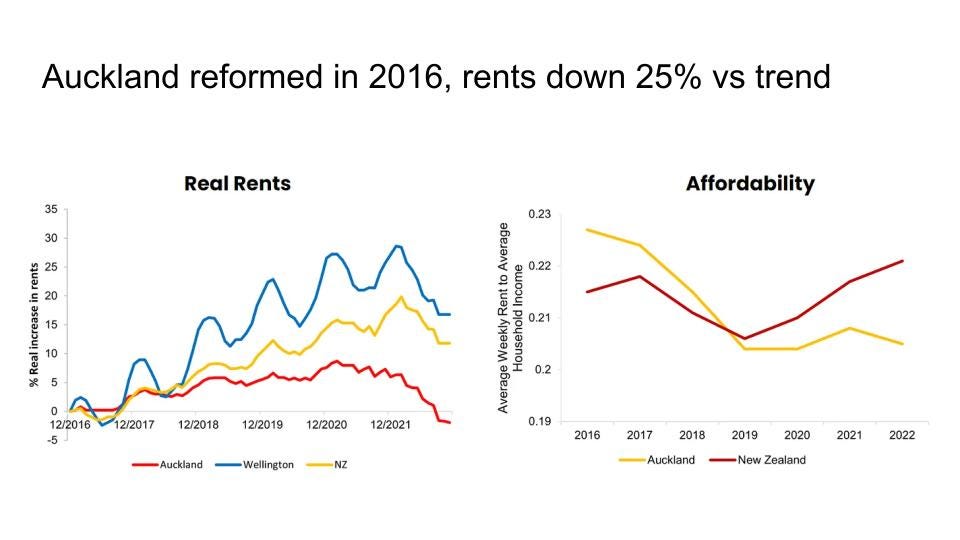
Auckland’s 2016 upzoning illustrates that yes, it’s possible to solve the problem. They’ve had a chronic housing shortage for a long time, resulting in high prices and rents. Ten years ago, in 2016, they updated their zoning to allow for more density by right on most of their land, in the form of buildings up to three storeys. Comparing Auckland to other cities in New Zealand, you can see that they were successful in improving affordability by bringing down rents.
More
Metro Vancouver Alliance. There’s a similar Civic Academy on climate on Saturday March 14.
This is why BC’s housing crisis hasn’t been solved yet. Alex Hemingway, BC Policy Solutions, December 2025.