Speaking notes: 320 West 2nd
Intensifying the use of land in a centrally located industrial area

[Update: approved unanimously.]
I’m signed up to speak at Thursday’s public hearing, regarding a rezoning application for 320 - 360 West 2nd. The rezoning would allow a 25-storey building with 2 FSR light industrial, 6 FSR market rental, and a $5.5M cash Community Amenity Contribution instead of below-market housing.
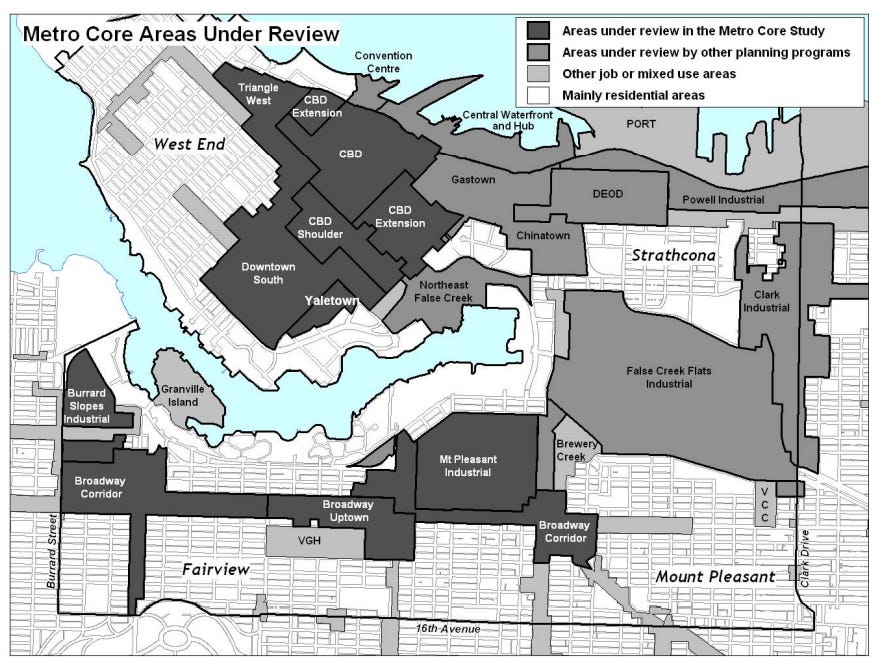
It’s on the northern edge of the Mount Pleasant industrial area, just south of Olympic Village. The site was previously approved for 2 FSR light industrial, 4 FSR office. It was excavated back in 2024, so it's been sitting empty since then.
Staff are opposed. The industrial zoning doesn't allow residential use.
Council passed a motion back in July 2025 asking staff to look at allowing mixed-use projects including residential in five industrial areas, including the Mount Pleasant industrial area. Staff are recommending that the applicant wait until they're done with their study, which will be in 2027.
19-storey flatiron rental housing tower proposed for Olympic Village SkyTrain station. Kenneth Chan, Daily Hive, October 2024.
Agenda: https://council.vancouver.ca/20260122/phea20260122ag.htm
Staff report: https://council.vancouver.ca/20260122/documents/phea4rr.pdf
Speaking notes:
Hi, my name is Russil Wvong. I’m a volunteer with the Vancouver Area Neighbours Association. I live in Vancouver, and I don’t work in real estate or development. I’d like to speak in support of this application.
Like a lot of hard decisions, this application requires weighing costs and benefits.
Industrial firms produce and distribute goods, as opposed to services. They typically require more land, and need to be located close to transport hubs, like Amazon’s facility near the port of Vancouver.
Land in Metro Vancouver is scarce and expensive. The pattern is that we get major offices and hotels in the centre, higher-density residential in central locations, and lower-density residential further out. Industrial uses which are sensitive to the cost of land and to congestion costs tend to move where land is cheaper.
The challenge in the city of Vancouver is that we have a chronic shortage of housing. The result is that residential use is the most valuable use of land, because people want to live and work here. The policy response so far has been to set up an industrial land reserve and forbid residential, kind of like the agricultural land reserve, or what Nathan Lauster calls the Great House Reserve, meaning all of the city land that’s reserved for low-density housing. In the case of the industrial land reserve, it acts as a subsidy for production and distribution of goods, because it lowers the rents for industrial uses.
I would point out that it’s pretty important to pay attention to prices. If the price that people are willing to pay for residential use in a centrally located area is really high, that’s a clear signal that we need to build a lot more housing. Trying to ignore or suppress prices seems like trying to drive while covering your eyes.
The problem of limited land is only going to grow more acute over time. For several years, people have talked about the idea of intensification, with multi-storey buildings for light industry, and in this case, buildings with light industry on the lower floors and residential on the upper floors. This seems like a reasonable solution.
The previously approved zoning allows for 2 FSR of light industrial space, with 4 FSR of office space above. The current application includes the same amount of light industrial space, 2 FSR, with 6 FSR of market rental above it, and $5.5M in cash to pay for below-market housing offsite.
The tradeoff - the cost - is that some industrial uses will be excluded, because there’ll just be too much friction with residents, whether from noise, smells, or operating hours, something like the restrictions in the low-density MC-1 and MC-2 zoning. And future projects in the Mount Pleasant industrial area will likely require the same kind of mix of light industry and residential to be viable, with the residential serving to cross-subsidize the industrial space. It may be helpful to provide some clear visual indication to future residents that this is an industrial area, maybe by painting the roads as you enter, in the same way that West 10th in front of VGH is painted.
It seems that the idea of intensifying land use by including both light industry and residential in multi-storey buildings is where we’re going to get to in the end. Council has already set the direction clearly, in the July 2025 motion. I haven’t seen any arguments saying that this particular project doesn’t make sense, that it’d be better to leave the site as a hole in the ground in order to reserve it for future industrial use. It’s just a matter of timing, how long it takes to work through the area planning process, and then build consensus.
Thank you.
Mario Polese observes that firms which are more sensitive to the costs of being in a large urban centre - high land costs, higher wages, and traffic congestion - will tend to move to smaller centres.
For some, the higher land and labor costs in the capital will outweigh the potential benefits of size. A firm requiring a great deal of space—an automobile assembly plant, for example—will give relatively more weight to land prices than a consultancy, which requires less floor space. The consultancy, in turn, will put a greater weight on face-to-face contacts with clients than would the auto plant. The auto plant would, on the other hand, put a higher relative value on the accessibility of road and rail infrastructures and the availability (and cost) of skilled blue-collar workers.
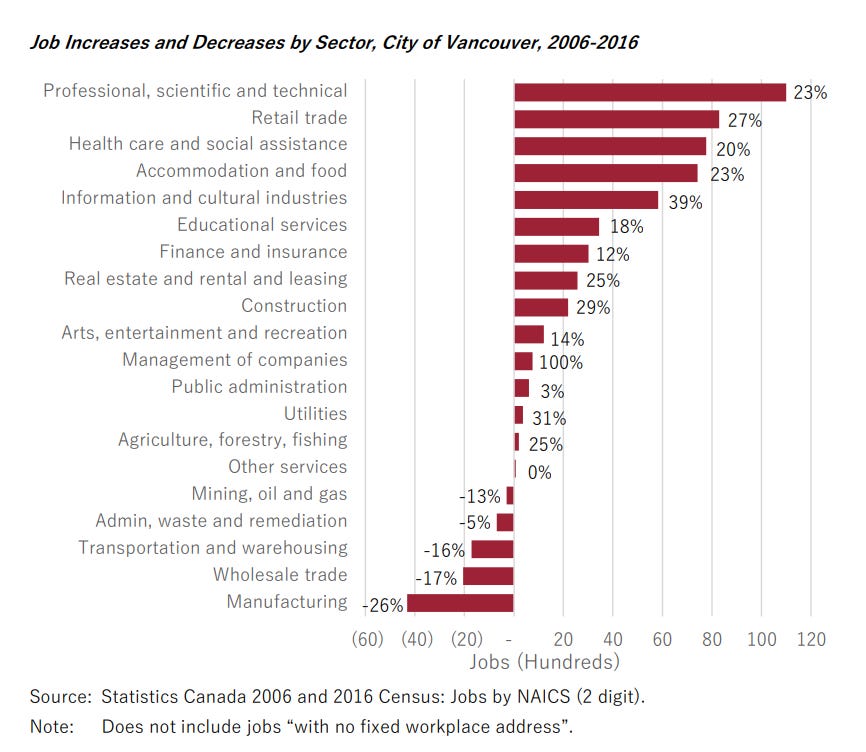
Given these factors, it’s not surprising to see that the city of Vancouver’s economy has been shifting towards services:
Some past reports:
November 2023: information report on multi-storey industrial
July 2025: motion directing staff to study adding housing to five sites, including the Mount Pleasant industrial area
December 2025: update
Five years ago, the report Employment Land and Economy Review: Phase 2 (2020) discussed mixed-use projects with light industrial on the lower floors and residential above.
Consideration of Rental Housing above Light Industrial on Key Sites
The City has limited ability to consider residential on sites that are designated as “Industrial” or “Mixed Employment” in the Regional Growth Strategy and Regional Context Statement Official Development Plan By-Law. Existing policy does contain a “municipal flexibility clause” but the amount of land that can be converted through the use of this provision is limited. In addition, use of the flexibility clause for privately initiated projects can limit and impact the City’s ability to deliver on Council objectives such as temporary modular housing for individuals experiencing homelessness.
The Metro Vancouver Regional Industrial Lands Strategy contains directions to explore rental housing above light industrial space as an option for encouraging intensification of industrial lands. Metro Vancouver has advised that consideration of rental housing above light industrial will be considered as part of the Regional Growth Strategy update process in 2021.
Future discussions regarding affordable rental housing above light industrial space will be guided by the following considerations to prioritize job space:
The maintenance or expansion of existing industrial space
The ability to achieve multi-storey industrial space where appropriate
The assurance of viability for industrial operations and provision of mitigation measures where appropriate
The prioritization of job-intensification around transit station areas in all scenarios
Future economic resiliency and flexibility for the city
The enhancement of liveability around station areas through public realm improvements, connected walking and cycling routes, and delivery of public amenities
Planning and investment in land use, utilities and transportation infrastructure that are resilient to current and future climate change impacts such as sea level rise and other hazards
Addressing concerns around the regional sewer system capacity with Metro Vancouver prior to intensification
More
Why we need to care about Metro Vancouver’s industrial land shortage. Eric Aderneck, Daily Hive, February 2024.
Vancouver mayor seeks to unlock development potential of five ‘exceptional’ sites. Kenneth Chan, Daily Hive, July 2025.
Previously:
Really solid breakdown of the tradeofs here. The industrial land reserve basically functions as a hidden subsidy, and when housing demand is this acute, that subsidy structure starts warping the whole system. I worked near a mixed-use zone once and the friction issues are real but totally managable with clearr zoning rules around noise and operations. Multi-storey industrial seems like the obvious direction when land scarcity is the binding constraint.
There is an abundance of highrise residential sites already in the 500 block Broadway “Corridor” and elsewhere in the City. Blockbusting very limited industrial and service ares for yet more is a stupid thing to do.