Auditor-general's report: delivery of in-kind Community Amenity Contributions

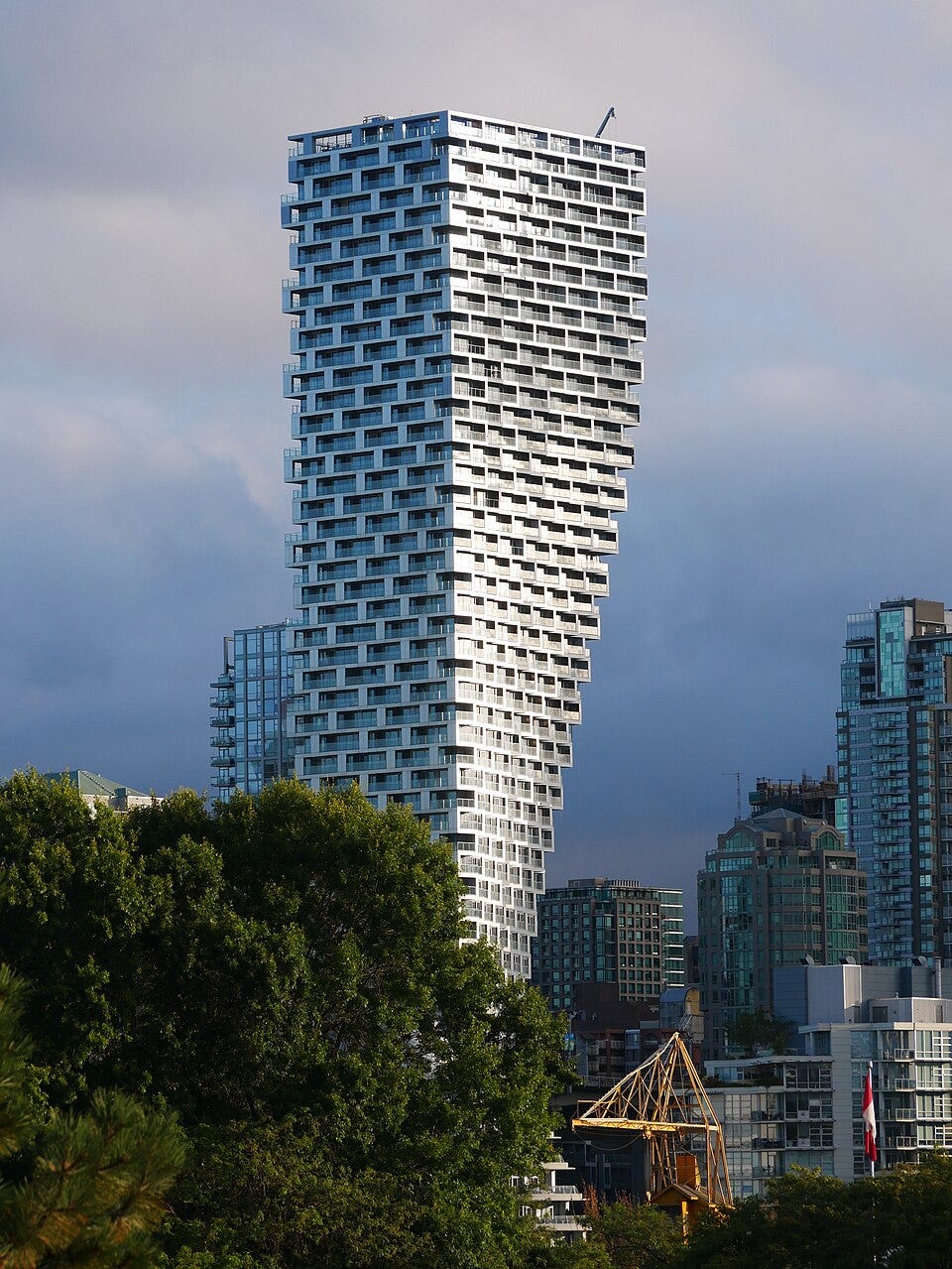
Justin McElroy on BlueSky:
Vancouver staff told council that if it rezoned land so a developer could build a big tower, the developer would spend $6 million on making the surrounding area nice.
The city’s auditor general found that didn’t happen, and that staff basically shrugged their shoulders about it.
The story: Vancouver’s auditor general criticizes city over lack of paper trail for lost developer amenities.
The auditor-general’s 2025 Whistleblower Report, reporting on investigations into complaints, includes this as one case study. When the site rezoning was approved for Vancouver House in 2013, city staff had negotiated $10 million in Community Amenity Contributions. The city is basically selling permission to build, in this case for $10 million. $4 million was in cash, and $6 million was for in-kind improvements to the public realm. In-kind CACs are quite common.
In this case, the in-kind CACs were described in an October 2013 report as:
A more direct and enhanced pedestrian connection (vertical elevators/stairs and horizontal bridge) between the upper Granville Bridge deck sidewalks and Granville Street below.
Public realm features, such as landscaping, seating opportunities, patio spaces and kiosks, need to be considered.
Pedestrian access through the terraced semi-public courtyards to Pacific Street should also be maintained.
Enhanced public realm treatment that contributes to the unique environment under the Granville Bridge and ramps.
Design development and provision of a conceptual lighting strategy and implementation plan for pedestrian scale lighting and feature lighting to enhance the unique under the bridge/ramp environment.
Provision of an animation strategy and implementation plan demonstrating the proposed use of City streets and structures, and provision of basic infrastructure, to support public realm programming. Basic infrastructure should be provided to facilitate event programming, including electricity, water, storage, and accessibility to public washrooms, including arrangements to secure public access.
What was delivered - not much
The complainant said that a lot of the public realm improvements had never happened.
When the Office of the Auditor General visited Vancouver House in October 2025, we found that the complainant’s description of the public realm surrounding the development was generally accurate:
The elevator from the development’s ground floor to the deck of the Granville Street Bridge was closed to the public. We were told by a security guard from one of the private commercial tenants in the building that this had been the case for several months.
The same security guard told us that there was no public washroom at the development, only one inside a nearby grocery store.
There was minimal landscaping between and around the Vancouver House development, except for a narrow strip of small plants near the entrance to the residential portion of the building on Howe Street, and street trees on Pacific Boulevard. Noticeably absent was any trees or other green spaces in the area around and under the Granville Street bridge.
There was limited seating, and no public patio spaces nor kiosks.
The intention of the in-kind CACs and the activation plan completed as part of the Development Permit Application was to create a space capable of hosting public events. However, the infrastructure to support event hosting did not appear present. There also did not appear to be any information that indicated that the area was available for public events or any amenities that would support public events. The space is not listed on the City’s Plazas and Public Space page, which lists options for organizing special events across the City. A preliminary web search by the OAG could not find any evidence that any public events had ever taken place in the public realm which was created as part of the in-kind CACs related to Vancouver House.
Who’s responsible for oversight of in-kind CACs?
Maybe nobody?
From the auditor-general’s report:
The Real Estate and Facilities Management department (REFM) is responsible for negotiating CACs, including the high-level in-kind deliverables. REFM is not responsible for overseeing the delivery of in-kind CACs, nor for holding developers accountable for them. REFM also told the Office of the Auditor General that the specifics of what in-kind CACs would look like for developments like Vancouver House are the responsibility of Engineering Services and the City’s Legal Services department. Legal Services told us they provide advice and draft agreement language for in-kind CAC amenities, as requested, based upon instructions received from the responsible department. However, Legal Services is not responsible for the specifics or details as to what an in-kind amenity will look like.
The whole process seems remarkably casual, given the monetary values involved.
If the city is really going to extract $10 million in Community Amenity Contributions from a project, it seems like a more straightforward approach would be to collect it in cash, and then pay for the desired amenities, with a contract that’s enforced. This may help to make the cost of the amenities clearer: they’re not “free” just because they’re being provided by the project.
A previous article:
Is it public or not? Group calls attention to lack of signage around Vancouver’s private-public space. Kevin Griffin, Vancouver Sun, December 2021.