Vacancy chains in Honolulu
A new condo building freed up cheaper apartments

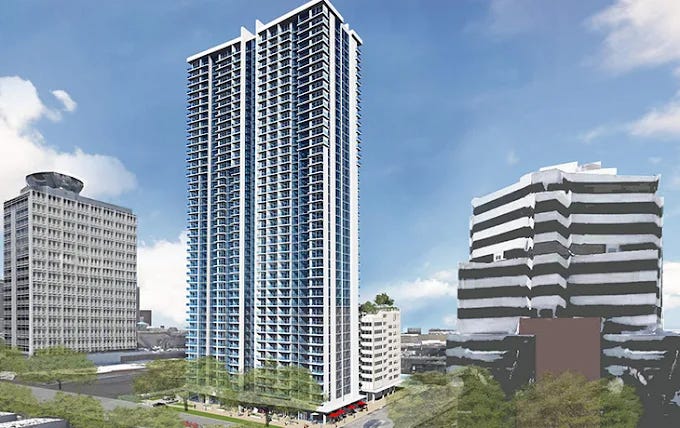
The Downmarket Impact of New Multifamily Housing: Evidence from a Honolulu Condo Tower. Limin Fang, Emi Kim, and Justin Tyndall, March 2026.
The construction of condominiums is often contentious. Critics argue that modern towers primarily serve investors and wealthy households, offering little to improve local affordability. For example, in Honolulu, a city councilmember, debating a 26-story condo project asked, “Where is the benefit to the Hawai'i working family?... I don’t see it with this property.” In contrast, a growing body of economic research argues that new market-rate housing supply generally enhances affordability through housing filtering, in which new units trigger vacancies in lower-priced market segments via household moves.
We present new evidence of housing filtering from one large development project. Our case is The Central, a 512-unit condominium tower in Honolulu completed in 2021.
They were able to track the previous addresses of 180 households who moved into the new building. They found that these moves freed up cheaper homes:
Price per square foot (PSF) declines across rounds relative to the project units (Round 0). Units in The Central averaged $1,152 PSF; Round 1 units averaged $715 PSF and Round 2 averaged $642 PSF. Thus, homes left behind by those moving into The Central were valued at 38% less than those in The Central, and homes in the subsequent round were 44% less than in The Central.
They also freed up larger homes:
A distinct criticism of new condominium towers is that they might fail to contribute the types of housing that are desired by the local population. We find that of the 180 homes that were vacated due to The Central, 40 are detached singlefamily homes, while the remaining 140 were units in multifamily buildings, ranging from duplexes to high-rise condominiums. Figure 6 provides Equation 1 results for two indicators of unit size (square footage and number of bedrooms) and the year of the unit’s construction. Overall, we find evidence that households, on average, downsize when moving into The Central, freeing up larger units. Panel A shows square footage results for the full sample (black dots) and for only units that actually resulted in a vacancy (gray dots).
Further research might quantify the breadth of home-values affected by construction at one value band. That is, how many $500,000 homes are freed up by the construction of $750,000 homes? ($650,000?) ... because some people were able to move up.
Moving up (in life) is fortunately more common than moving down. But, most people wish that Boomers could be talked out of their mostly-empty homes into a downsize.