Griffintown: Why does everyone hate this Montreal neighbourhood?
Oh the Urbanity! on urban design

Oh the Urbanity! talks about urban design and the Griffintown neighbourhood of Montreal (which he thinks is unfairly criticized). I really liked his discussion of what’s most important in urban design:
Another reason I find discussions of aesthetics frustrating is that they often don’t capture what actually makes or breaks the experience of a neighbourhood for me. If we’re setting aside concerns like housing supply and focusing purely on the livability of the public realm — including aesthetics but also other parts of the experience — the number one factor for me is street design. How big are the sidewalks? Are there bike lanes? Are the streets loud or dangerous? Are there street trees, furniture, patios?
After street design, the second most important part of the public realm to me is how the buildings meet the street. This is where Montreal’s old neighbourhoods really shine. The doors and staircases open directly onto the street and give a lot of detail, life, and interest. Some have detailed gardens out front and I think this looks awesome, way better than a suburban lawn. Ground floor retail is another option, although people sometimes forget that not every building can have it, there just isn’t enough retail demand for that.
The third most important factor for me is the architecture of the building as we traditionally think about it: designs, colours, materials, and patterns above ground level. As mentioned, I tend to find the red or beige brick facades nicest, maybe because they’re historically common in Montreal. Although I can’t escape the feeling that a lot of these judgements are particularly subjective.
And the fourth (and least) most important part of the public realm is the height of buildings. I’ll grant that taller buildings can make a space feel less “cozy”, I just think this is less important than all the other things I’ve covered. Taller buildings also block sunlight, which is maybe a negative overall, but it’s definitely not always a negative. “This building is blocking the sun from hitting me now. But you know what? I don’t want to be in the sun, it’s 31 frickin degrees.”
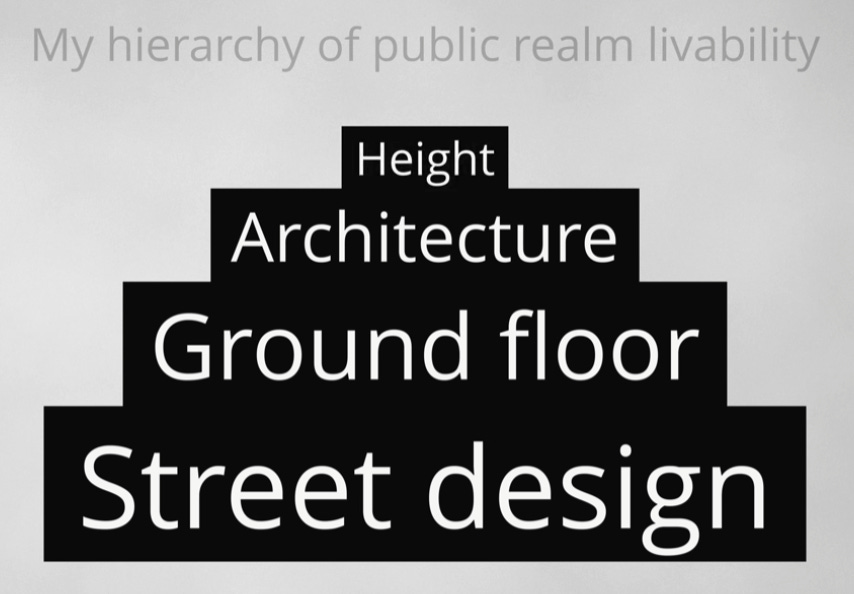
This is my hierarchy of public realm livability. What matters most is the experience at street level. It takes up most of your vision, and affects you beyond aesthetics.
This is similar to what I’ve heard from Gordon Price about urban design in Vancouver. What’s most important is good street-level design, because that’s what you see. Rarely do people walk around looking up towards the sky.