Dueling recommendations for Gregor Robertson
Allow more market housing vs. more money for non-market housing

Allow more market housing
There is a way to increase housing supply. Does Gregor Robertson have the will? Mike Moffatt, Toronto Star, July 2025.
A good overview of sensible ideas:
Reduce the cost of land, by requiring municipalities to meet their commitments to allow more density under Housing Accelerator Fund agreements, and by making federal land available for housing.
Encourage more family-sized housing, by allowing European- and Montreal-style apartment buildings around a central staircase instead of requiring a hotel-style layout, and adopting EU elevator standards.
Reduce the cost of owning, by expanding the GST/HST rebate, and by breaking out development charges as a separate line item that you don't pay tax on.
Encourage investors to build new rental housing via MURB tax incentives (accelerated depreciation which can be used to offset other taxable income), instead of competing with first-time homebuyers to buy condo apartments.
Put more money into non-market housing
Why the ‘build more homes’ mantra won’t cut it. Steve Pomeroy, James R Dunn, and Duncan Maclennan, Toronto Star, July 2025.
Acknowledges the need for more supply, but downplays it:
Despite the urgency and complexity of the challenge, the dominant response continues to be an oversimplified mantra: “build more homes.” While supply is clearly part of the solution, framing unaffordability primarily as a chronic supply problem — caused by sluggish municipal approvals or “NIMBY” zoning — is a dangerous oversimplification.
Argues that there’s three key challenges requiring targeted solutions:
This isn’t a single problem. It’s a system failure playing out in three interconnected but distinct ways: rising homelessness, worsening rental affordability, and shrinking access to home ownership. Each requires a different policy response, yet federal plans remain heavily tilted toward market-based supply solutions.
I'd describe the perspective here as being similar to the 2017 National Housing Strategy, which focused on putting more money into non-market housing. What's changed since then is the massive Covid-induced surge in people working from home, needing more space, and willing to move, which caused the housing shortage to spill over from Toronto and Vancouver across the entire country. Plus there was the post-Covid international-student boom on top of that. The housing shortage is now affecting younger people and renters all the way to the top of the income scale.
The article mentions “shared-equity models”, which is similar to BC’s Attainable Housing Initiative (home ownership at 40% off).
Why not both?
Of course the obvious thing to do is pursue both more market housing and more non-market housing, keeping in mind that market housing scales up. If you can open up the bottlenecks to market housing, you don’t need to keep putting in more money to get more built.
I'm a huge fan of non-market housing options, but if we are treating them as a replacement to market housing rather than a supplement then you need to dramatically scale up the size of government (eg think of the $35 billion price tag for 65,000 units being discussed in Toronto).
What's the best approach? We want to expand supply as quickly as we can, and the best way to do that is allow the market to build as quickly and with as little administrative costs as possible.
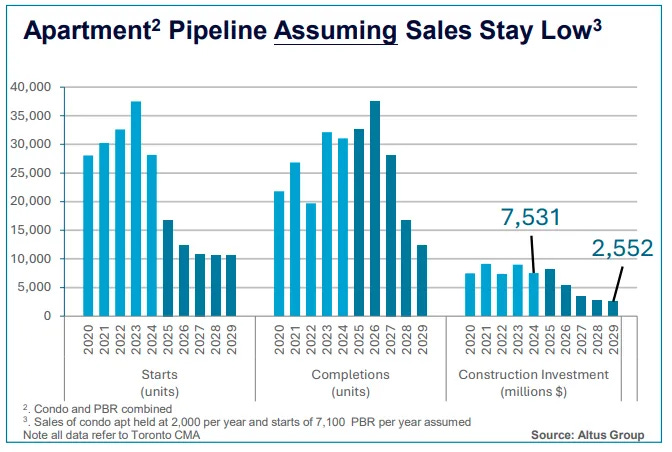
We can then layer public provision on top, which should ideally play an important countercyclical role (e.g. picking up building slack during market downturns) and in signaling that the industry as a whole can continue to expand rapidly with a degree of confidence.
More
Impatience is a virtue - summary of what the BC government’s been doing. It’s probably a good idea for the federal government to take a close look.
NYC's Housing Supply Crisis is Two Separate Problems. Daniel Golliher, Maximum New York. “New York City’s housing supply crisis is often mistaken for one problem. In reality, it’s two distinct problems stacked in a trench coat: (1) a general supply shortage that affects most New Yorkers, and (2) a chronic supply/affordability crisis for the very poorest that is exacerbated by the first problem.”
An opposing view: single-family residential character is more important than building more housing. 'They were just hell-bent': Mayor battling Ottawa over 'really left' housing mandate. Drew Dilkins, mayor of Windsor, arguing that the federal government requiring four-plexes in exchange for access to Housing Accelerator funding is unreasonable.
Another opposing view: building more housing isn’t going to make housing less scarce and expensive. Advancing Housing Affordability Through Bold, Evidence-Based Policy. By Patrick Condon and others.
'...countercyclical role (e.g. picking up building slack during market downturns)...'
Noah Smith talked about this on a recent podcast with Derek Thompson and it made intuitive sense when I heard it. But he said that countercyclical housing construction often doesn't happen—iirc because builders/bankers seem to have a hard time, during a downturn, maintaining faith that it will end ... even though cycles are always the way things go.
Great piece!