Image of the day: up-front infrastructure costs are one-third lower for infill housing
Research from Pew Charitable Trusts on the fiscal impact of infill housing

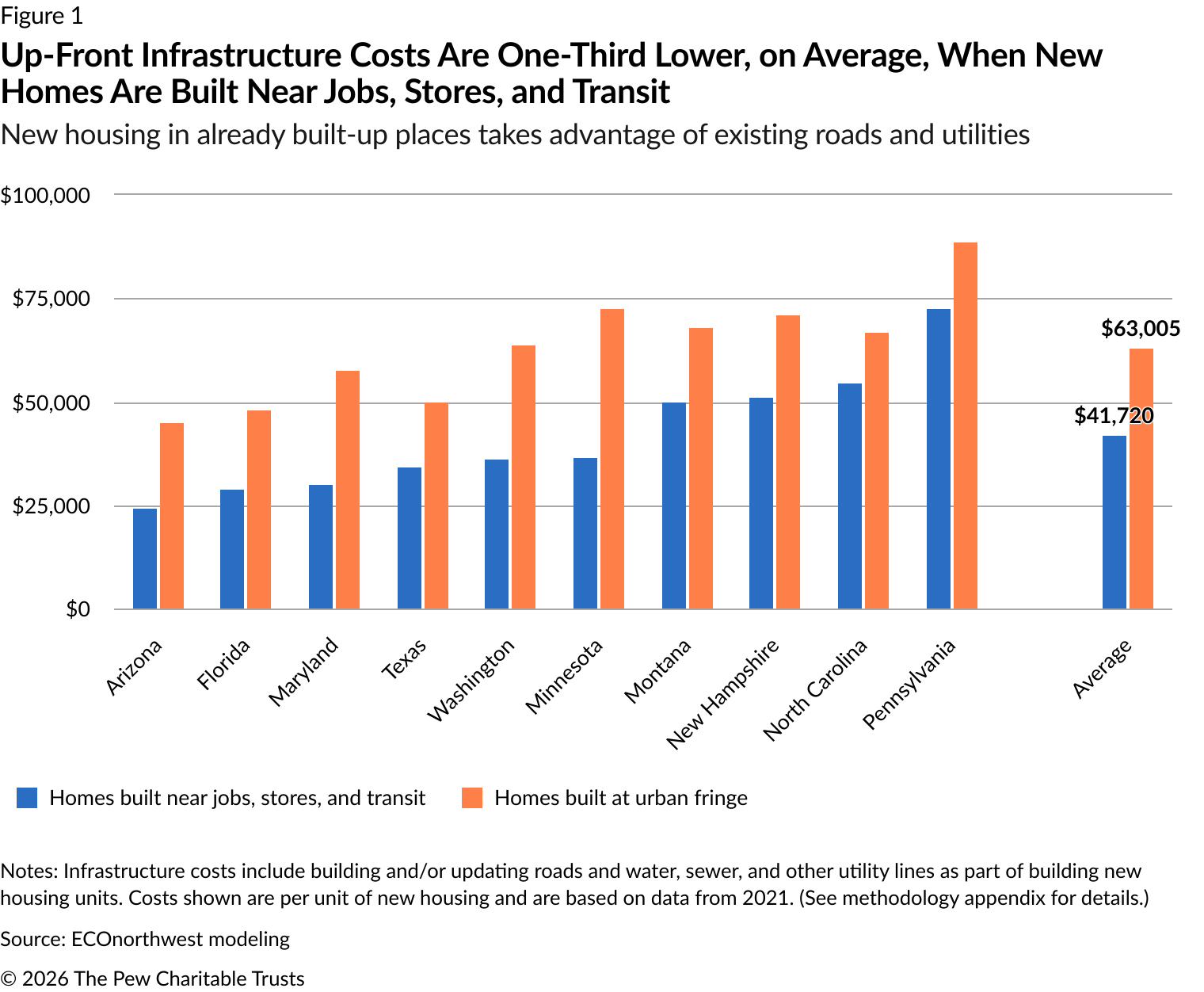
Building Homes Near Jobs, Stores, and Transit Saves Public Dollars. Seva Rodnyansky, Tushar Kansal, Ben Holland, Justyn Huckleberry, Jyot Chadha, Ian Carlton, and Natalie Walker, Pew Charitable Trusts, May 2026.
This research used economic modeling to estimate the fiscal impact of new housing in 10 states of vastly different sizes and geography: Arizona, Florida, Maryland, Minnesota, Montana, New Hampshire, North Carolina, Pennsylvania, Texas, and Washington. For each state, researchers modeled the number of new homes needed to relieve housing shortages over the next decade and how public costs and revenues would vary according to the type, location, and density of housing.
Key findings include:
The up-front cost to government and taxpayers of building roads, water and sewer lines, and other public utilities to serve new homes near existing jobs, stores, and transit is approximately $21,000 lower per home than the infrastructure costs associated with building homes at the outer edge of cities and towns.
The ongoing costs to government and taxpayers of maintaining roads and utilities that serve new homes are 50% lower, on average, when those homes are built near existing jobs, stores, and transit.
Property taxes generated per acre are 13% higher, on average, when new homes are built near jobs, stores, and transit.
On average, the payback period for infrastructure associated with new homes is 50% longer when those homes are built in outlying areas than when they are built near existing jobs, stores, and transit.
Local government can keep property tax rates down while maintaining healthy balance sheets when more housing is built in established areas.
Stephen Rouse’s analysis for Metro Vancouver: