Federal funding for municipal infrastructure
$51B over 10 years

The federal government’s Budget 2025 included $51B in federal funding for municipal infrastructure, called the Build Communities Strong Fund. This week, Mark Carney officially launched the fund. There’s three streams of funding:
$17.2B over 10 years to support provincial projects and priorities (“Provincial and Territorial stream”), based on negotiation and cost-matching from the provinces.
$6B over 10 years for federally funded projects (“Direct Delivery stream”).
$27.8B over 10 years for local projects (“Community stream”), and $3B/year after that. This is what used to be the Canada Community-Building Fund.
In particular, it looks like the “Provincial and Territorial stream” is the source of the federal funding for Ontario’s announcements in the last couple of weeks. Ontario’s plan is to use $8.8B in funding ($4.4B from the federal government and a matching $4.4B in provincial funding) to expand the HST waiver to all new homes in Ontario, and to shift the burden of funding municipal infrastructure away from heavy development charges on new housing.
The announcement this week:
Carney breaks down plans to spend $51B on local infrastructure over a decade. Greg Lord, Canadian Press.
British Columbia to get $2.2B from federal community fund. Amy Judd, Global News. The initial list of projects includes some funding for the Marpole Community Centre renovation project in Oak Park.
Press release from March 30, on the agreement between the federal government and Ontario:
Today, the Prime Minister, Mark Carney, alongside the Premier of Ontario, Doug Ford, announced a new partnership between Canada and Ontario to build more affordable homes, infrastructure, and transit. This partnership will reduce taxes and fees for a home in Ontario by up to $200,000.
To boost housing supply for Canadians and lower costs, the federal and Ontario governments will:
Lower development charges: The federal government and Ontario will cost-match a total of $8.8 billion over 10 years, focused on housing-enabling infrastructure projects. This funding will support the reduction of municipal development charges by up to 50%. These reductions will be in place for three years and target municipalities covering 80% of the province’s population. This new infrastructure funding will offset much of the financial impact of development charge reductions on municipalities. However, municipalities will also be expected to support development charge reductions, so that all three levels of government are supporting increased housing supply and affordability. The province will work with municipalities to put forward a list of infrastructure projects for approval with a focus on speed and efficiency. Development charges are a major upfront cost that can delay or prevent new housing projects. Lowering these upfront costs will help accelerate construction and build more homes. This marks the federal government’s first partnership through the Build Communities Strong Fund.
Tax relief for homebuyers: Building on the elimination of the GST for first-time homebuyers last year, through this partnership, the full 13% of the HST will be removed for new homes in Ontario valued up to $1 million, saving buyers up to $130,000 on the purchase of their home. This maximum rebate of $130,000 would be maintained for new homes valued up to $1.5 million, and would decrease proportionally from $130,000 at $1.5 million to a maximum of $24,000 for homes valued at $1.85 million and above. This would apply to eligible agreements signed between April 1, 2026, and March 31, 2027. The Ontario government estimates this measure will deliver nearly $2.2 billion in tax relief, support an additional 8,000 housing starts next year, create up to 21,000 jobs, and contribute $2.7 billion to Ontario’s GDP.
Previously:
More:
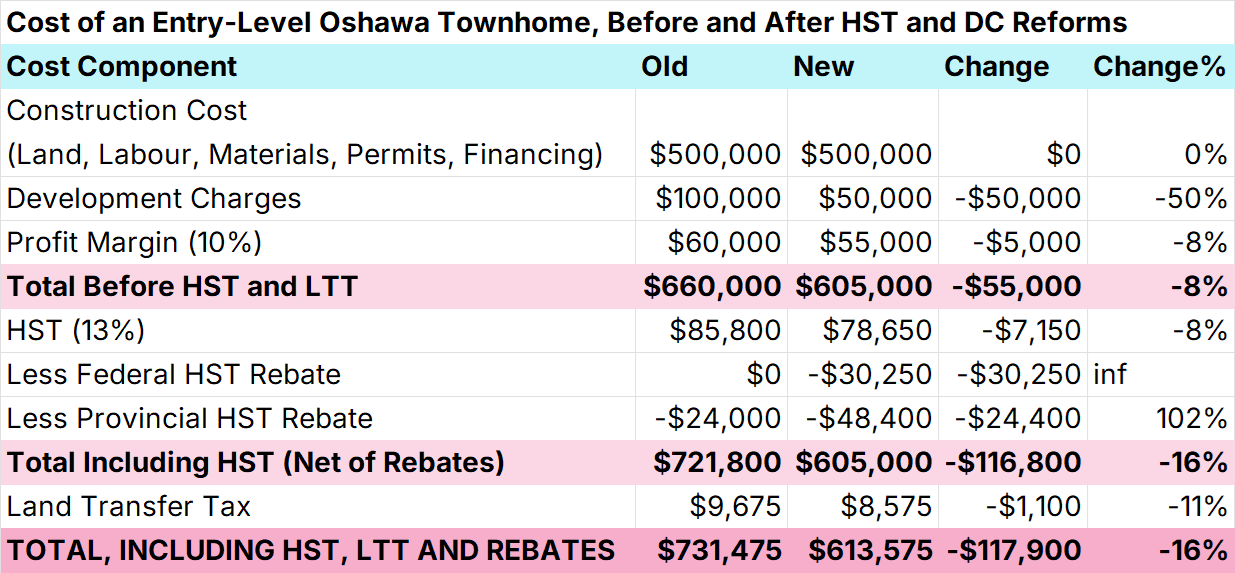
Correcting a Decade of Over-Taxing New Housing. Mike Moffatt, Missing Middle Initiative. Includes an example of what kind of impact this would have on prices. “This is a substantial reduction, and should allow more homes to be built, and sold to consumers at lower prices, as the market for new $614,000 townhomes is substantially higher than the market for $732,000 ones.”
Mike Moffatt also has an op-ed in the Star. Doug Ford and Mark Carney have bought Ontario some time. But the hard choices lie ahead.