Buildings Seismic Risk Reduction Action Plan
Vancouver's plan for the next big earthquake

Seismic Risk and Risk Reduction in Existing Privately Owned Buildings. Staff report, November 2024.
Buildings Seismic Risk Reduction Action Plan. Staff report, May 2026. On the agenda for tomorrow’s council meeting.
Risk = probability x impact. It’s difficult to plan for events that are low-probability, but high-impact. The next big earthquake is a good example. According to Natural Resources Canada, there’s a 20% chance of a major earthquake occurring here in the next 50 years. From the November 2024 report, Appendix A:
Modelling shows that a large earthquake could result in nearly 6,100 heavily damaged buildings, leading to over 1,350 severe injuries and fatalities, the disruption and displacement of over one-third of residents and workers for more than three months, and over $17B in direct financial losses. Even a less intense earthquake, like the one used in the 2019 VanSlam earthquake exercise, could leave as many as 25,000 residents and workers disrupted or displaced for more than three months and cause as many as 200 severe injuries and fatalities.
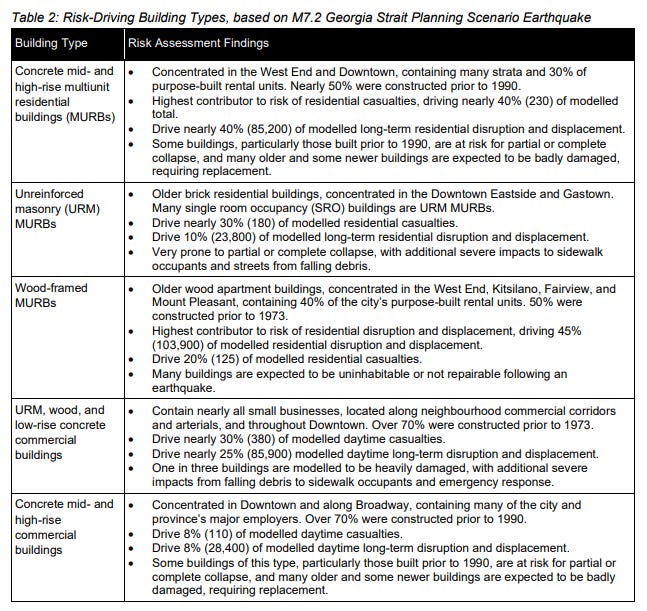
Risk assessment based on building type:
The current report makes the following recommendations:
Set up a technical working group.
Create a public inventory of at-risk buildings.
Set up a voluntary seismic upgrade program, intended to support incremental safety improvements so it’s not just all-or-nothing.
Consider redevelopment to reduce risk - a new building will be safer than an old one built before seismic standards.
Make changes to Vancouver’s building regulations to improve earthquake safety.
Pay particular attention to impacts on vulnerable populations, like people living in SROs (rooms rented without a kitchen or bathroom, now illegal to build). “Nearly all SROs were built fifty years prior to the introduction of seismic design into Vancouver’s building code, making them amongst the most critically at-risk buildings in Vancouver.”
Improve post-earthquake recovery, not just life safety during an earthquake.
A couple comments:
All of the references seem to be to Anglophone jurisdictions. I didn’t see any mention of Japan, which has frequent earthquakes. Apparently buildings in Japan over 20 storeys use something called base isolation, where high-rises are detached from the moving ground.
Single-detached houses were excluded from the study. “Per the City’s directive, this study excludes 79,000 single-family homes.” According to the BC Earthquake Alliance, most structural damage for single-family homes is caused by homes sliding off their foundations.
More
Earthquake and Tsunami Preparedness Guide. BC government, March 2024.
After Great Disasters. Laurie A. Johnson and Robert B. Olshansky, 2017. A book on post-disaster recovery, including case studies from major earthquakes in Japan and New Zealand. The e-book versions (PDF and EPUB) are free.
Good discussion for dwellings. But of course, they're all just places to die slowly in if there are no services. So it's that massive, terrible cost increase on the sewage treatment plant that was the real earthquake preparation that public policy can at least directly tackle. Make sure the water and power are on, afterwards, that the hospitals all stand, have backup water treatment.
Most of Vancouver dwellings will stand, but people need to be prepared with that 72 hours of everything they need, at all times. I got into that when we came out here, and keep the supplies updated.