Demand-side measures are more popular than supply-side
Easier to relate, easier to understand

Shaddy, Franklin and Hagen, Linda and Hamilton, Ryan, When the Rent is Too Damn High: Why People Prefer Demand-Versus Supply-Oriented Policy Solutions to Scarcity (April 09, 2025). Available at SSRN: https://ssrn.com/abstract=5249803 or http://dx.doi.org/10.2139/ssrn.5249803
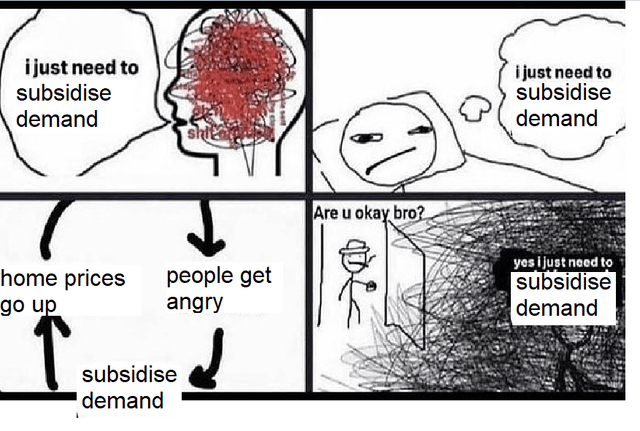
Academic version of this meme:
Abstract:
Any time demand exceeds supply, scarcity can result. When high prices inevitably follow, policymakers often propose one of two types of policy solutions: those that subsidize demand (e.g., giving people money to help them pay for scarce goods and services) and those that subsidize supply (e.g., giving producers money to help them increase the quantity of scarce goods and services).
Do people generally prefer demand- or supply-oriented policy solutions to scarcity? Seven preregistered experiments (total N = 4,594) document a systematic preference for demand (vs. supply) subsidies — that is, a demand subsidy bias — and test two key psychological factors to explain why.
First, people are better able to relate to those who directly benefit from demand subsidies (e.g., other consumers or buyers), relative to those who directly benefit from supply subsidies (e.g., suppliers, manufacturers).
Second, demand subsidies feel less causally complex (i.e., they seem easier to understand) than supply subsidies.
More
Summary of demand-side policies implemented in BC starting around 2022. BC started on the demand side, before pushing hard on the supply side.
I love the meme!