Building consensus
What can most people agree on?

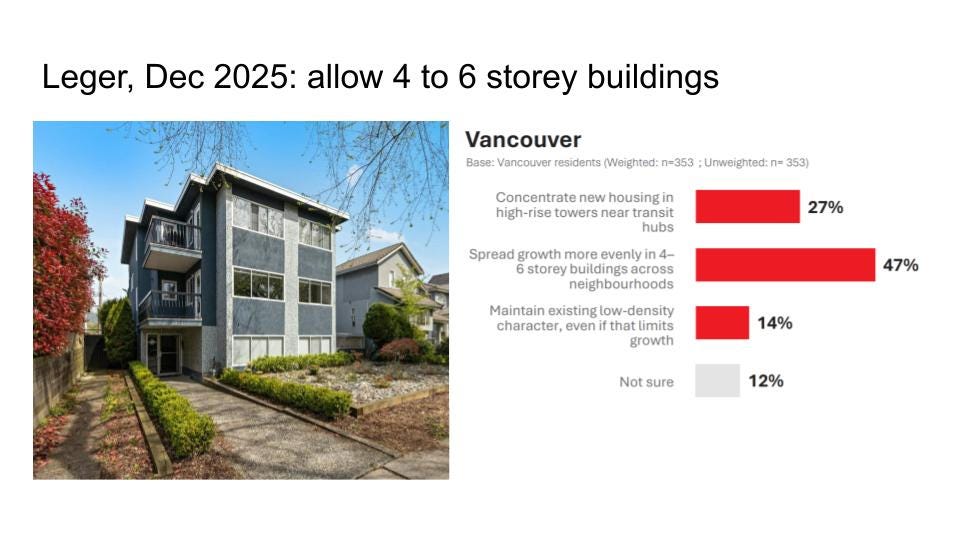
I suspect one of the reasons that Ken Sim hasn’t made much progress on streamlining approvals (“3-3-3-1”) is that he’s accustomed to running a business, where you can make sweeping decisions and just tell people what to do. When you’re running a government, you need to build consensus, which takes time.
This doesn’t mean that literally 100% of people will agree on everything. Leger’s December 2025 poll found that 14% of Vancouverites would prefer to stick with the status quo. But in a democracy, 86% is pretty good.
Of course there’s still six months until the election, so we do have some time to build consensus. What are the key elements of this consensus?
Four- to six-storey buildings
Land is limited by the ocean and the mountains. To add more housing, we need to build up. In Leger’s poll of Vancouverites, four- to six-storey buildings across neighbourhoods was the most popular option.
Why do we need more housing? Housing being scarce and expensive is bad for everyone, including older homeowners. Where will our kids live? When younger people can’t afford to live in the region, the healthcare system will be under increasing strain, with hospitals having a hard time hiring nurses and even doctors. As people retire, we need younger people to fill those jobs; without growth, our workforce will shrink. Prices and rents have been coming down recently, but they’re still far too high.
We should build as much non-market housing as we can, such as co-ops. But the amount of non-market housing we can build is limited by people’s willingness to pay for someone else’s housing, when they’re already stretched to the limit themselves. To fix the housing shortage, we need to fix the market side.
Costs matter
Costs set a floor on prices and rents. As Josh White puts it, city staff are accustomed to rising prices covering increasing costs (“bailing us out”). To keep building as prices and rents come down to a more reasonable level, we need to lower costs. To reduce the cost of the slow and labour-intensive approval process, we can set priorities and reduce micromanagement, especially for four- to six-storey buildings. To reduce the cost of land per square foot of floor space, we can allow more floor space.
In particular, we need to rethink our reliance on heavy one-time taxes on new housing, and relatively light annual property taxes (which inflates prices). This isn’t going to be easy: Mario Polèse calls it a “fiscal trap door,” difficult to close once opened.
Better community services and infrastructure
Our light annual property taxes have resulted in severe underfunding of infrastructure, evident in the state of our older community centres. As Vancouver grows, we don’t just need housing. We need libraries, community centres, and schools; we need roads and public transit; we need water, sewers, garbage collection, and electricity.
And infrastructure wears out over time. We need enough revenue to keep our infrastructure in a state of good repair. Some of Vancouver’s water and sewer infrastructure is more than 100 years old. We can’t just build new amenities and infrastructure when there’s new development, while letting our older infrastructure rust out.
Previously:
Great points, especially about needing young people to move in to the city to do the work when the old people retire, and they need affordable housing to do that.
Someone give this man a city council seat immediately!!