CMHC's 2025 market rental report
Good news for a change!

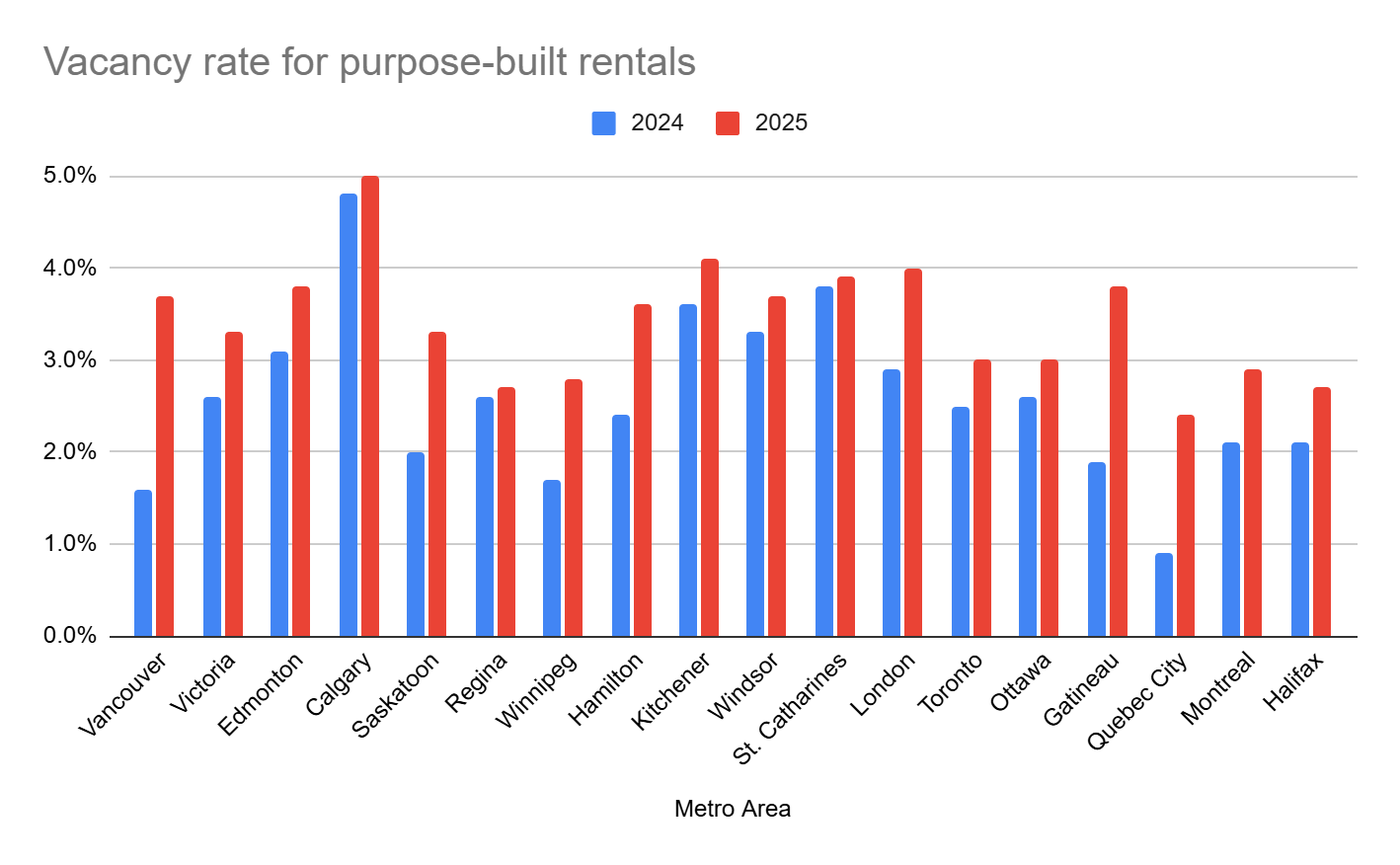
CMHC publishes a Rental Market Report each year, describing rental markets in metro areas across the country. The latest report, describing the market in October 2025, was released last Thursday.
The vacancy rate for purpose-built rentals in Metro Vancouver is 3.7%. It hasn’t been this high since 1988!
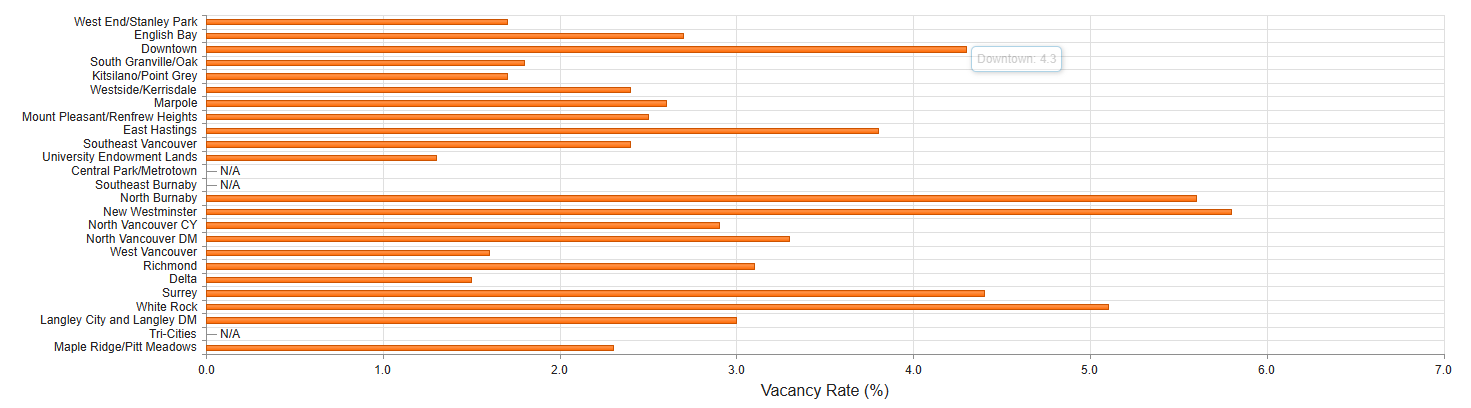
Vacancy rates in Metro Vancouver, as of October 2025:
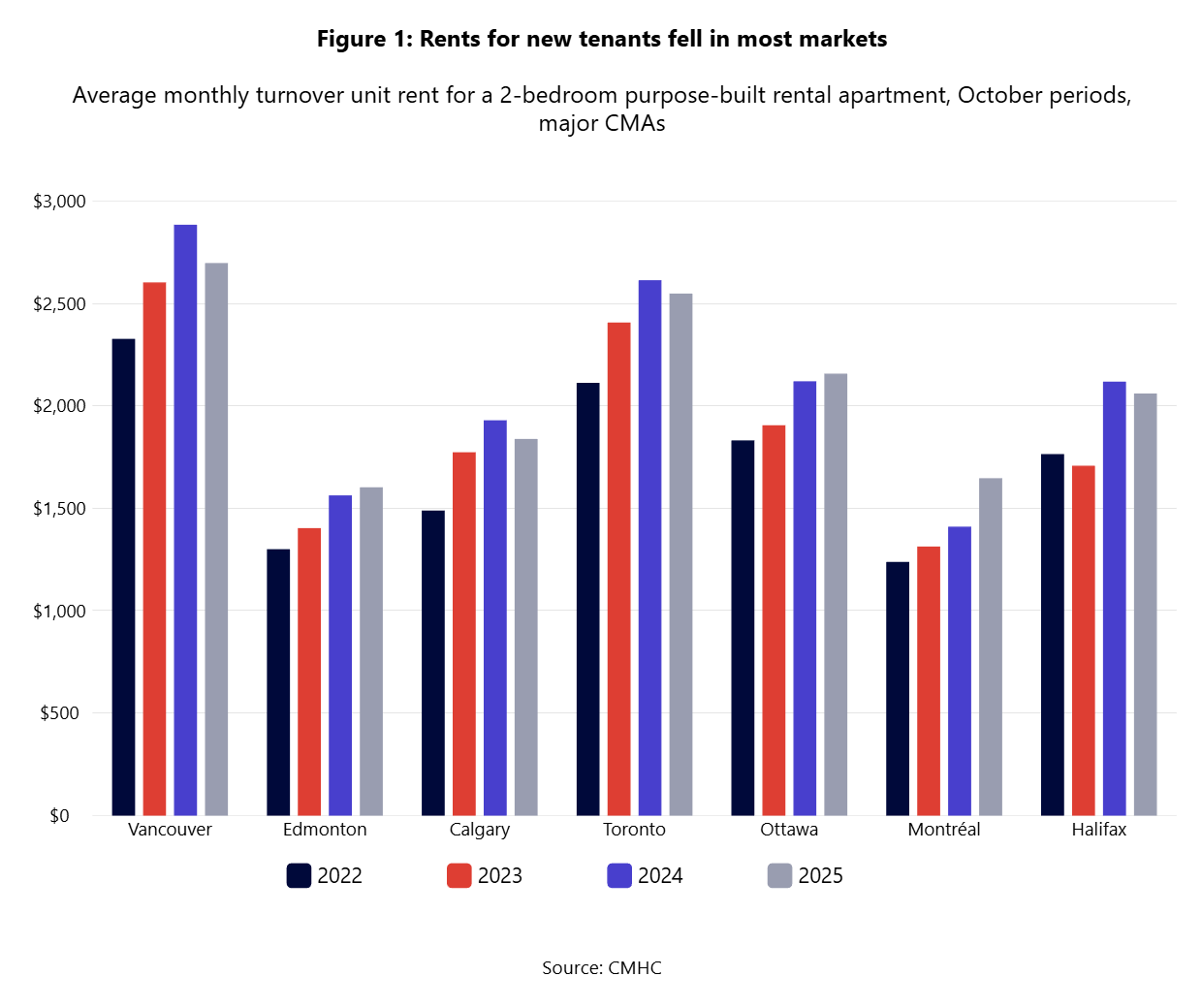
There’s a close relationship between vacancy rates (shown below in blue) and asking rents (shown in red). A vacancy rate of 3% is roughly where the market is balanced, with neither upward nor downward pressure on asking rents. When vacancy rates drop too close to zero, rents spike. When vacancy rates are high, landlords lower their asking rents to fill vacancies. This motivation is especially strong for individual owners: when you own and rent out a single condo apartment, your effective vacancy rate is either 100% or zero.

Reading through the report, it appears to be primarily good news (from the perspective of renters, not landlords!). There’s a combination of more supply and weakening demand, especially because there’s fewer international students. There’s more competition among landlords as they try to fill vacant apartments, putting downward pressure on asking rents. Renters are more willing and able to move.
That doesn’t mean that everything’s fine. Asking rents in BC and Ontario have been coming down a bit, but they’re still high. We need to keep building, to keep pushing down rents.
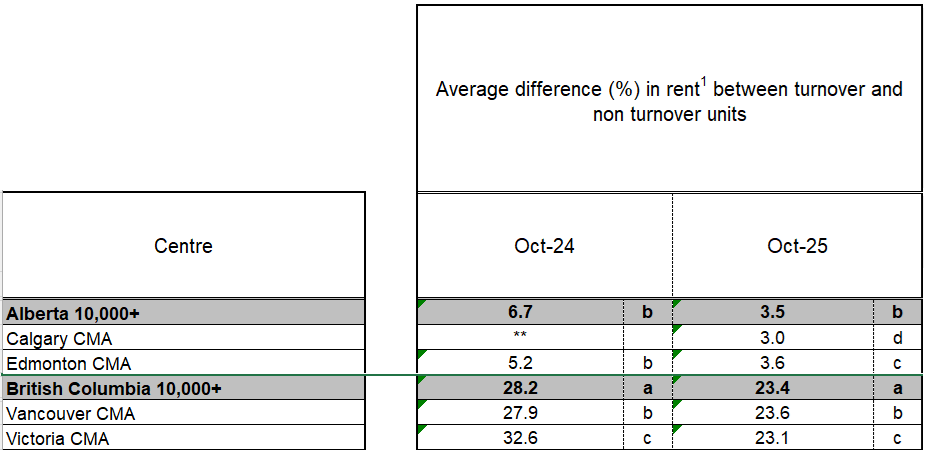
In BC and Ontario, the gap between non-turnover rents (for an existing tenancy) and turnover rents (for a new tenancy) is narrowing a bit, but it’s still very large.
A longer-term view
Some historical data from Ben Rabidoux. Metro Vancouver is the black line. It’s been a very long time since the vacancy rate here was above 3%.
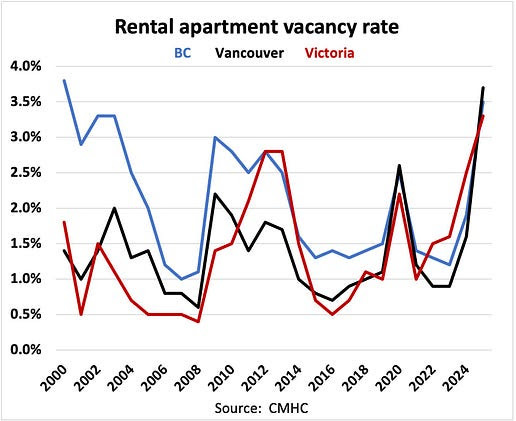
The usual pattern is that when the economy is strong and demand is high, it takes a long time for supply to respond, because of extremely slow approval processes; so the vacancy rate gets driven downward. And then when there’s an economic downturn and demand weakens, what often happens is that a lot of supply arrives from projects launched years previously, driving up the vacancy rate.
There’s two challenges facing municipal governments, and especially the city of Vancouver: because of its geographically central location, with easy access to lots of jobs, demand is especially high here.
One is speeding up approvals so that strong demand results in supply more quickly, keeping asking rents more stable, instead of vacancy rates close to zero and skyrocketing rents.
The other is lowering costs so that homebuilding can continue, even with lower rents.
Previously:
More
B.C. rents continue downward trend, down nearly six per cent. Cheryl Chan, Vancouver Sun, November 2025. Latest data from Rentals.ca.
More rentals are sitting empty in Canada. But it’s not enough to relieve housing affordability, CMHC says. Mariya Postelynak, Globe and Mail.
Despite more rental units being available, many Canadians struggle with unaffordable rent. Heather Wright, CTV News.
Kelowna boasts highest vacancy rate of any Canadian metropolitan area. Klaudia Van Emmerik, Global News. “Kelowna’s vacancy rate is now sitting at 6.4 per cent, up significantly from 3.8 per cent last year.”
I appreciate the article. It is nice to see our housing crisis improving. But I do have a nagging worry.
How much of this reduction in price is due to fixing supply constraints and how much is due to less immigration? Immigration is generally good for the economy. On average more immigration makes us all wealthier.
Now surely there is some optimal amount of immigration based on balancing different economic factors and I won't pretend to know what that is. I would love to learn more about how we might come up with such a number and if our recent federal targets are anywhere close (my hunch is that they are much lower than is optimal).
It seemed like the zeitgeist amongst housing advocates a year ago (which seemed true to me too) was that the best solution to high housing costs was reducing supply constraints. But now that we've achieved lower housing costs after dramatically reducing immigration, it's unclear if we should really celebrate that. Do we really want lower rents if it comes at the cost of slower economic growth?
Of course the answer depends on the magnitudes in question, which again I don't know, but evaluating that doesn't seem to be a part of the conversation anywhere. Would love to see a post on it.
The” indigenous” people were settlers who came from Asia . If 5,000 migrated to this new world in one year . Does that mean they can claim all the territory for themselves. If a new group of 5000 Asians arrive 2 years later can the first group seriously tell the 2nd group sorry it’s all ours we were here first. The earth belongs to all of us. Indigenousness is an accident no one is here first and why should we carve . A more serious approach would be how can we productively live together or along side each other Indigenousness is a kind of class or racism an artificial grouping to keep the other out . Time to take a step back and ask how we can embrace each other and not totemicly hold on to land . Learn from territorial mammals who after a minor display of of size and strength make room for each others packs