Canada-BC agreement to provide infrastructure funding and reduce development charges
Plus a controversial plan to convert market condos to non-market housing

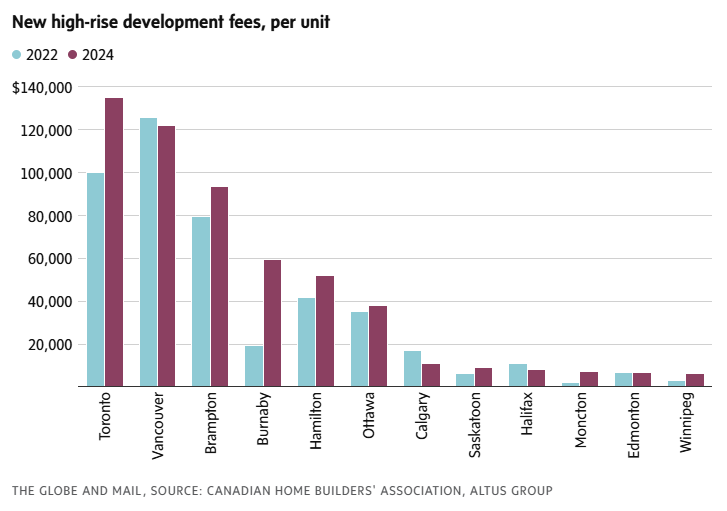
In Metro Vancouver and the GTA, there’s two major barriers to new housing:
The approval bottleneck. Getting approval to build new housing is slow and difficult, and delays increase the cost of new housing.
The cost bottleneck. Even if something is legal to build, when costs are too high it won’t get built. Declining prices, in combination with high development charges in Metro Vancouver and the GTA, have been pushing more and more projects underwater.
High development charges are primarily a problem in Metro Vancouver and the GTA. Mario Polèse describes the municipal decision to tax new housing heavily as a “fiscal trap door”: once you go through, it’s very hard to get out.
The 2025 federal budget included $12 billion over 10 years for a Build Communities Strong fund, to fund municipal infrastructure. The conditions on the fund:
To access funds, provinces and territories must agree to cost-match federal funding and to substantially reduce development charges and not levy other taxes that hinder the housing supply.
In March, the federal and Ontario governments announced that they’d reached an agreement to cut development charges significantly (the headline was “in half”). Federal, Ontario governments to spend $8.8-billion to cut municipal development charges.
Last Thursday, the federal and BC governments announced a similar agreement. The press release from the federal government:
Through the federal government’s new Build Communities Strong Fund, we will invest:
Nearly $1.6 billion over 10 years – matched by British Columbia for a total of up to $3.2 billion – to lower development charges for multi-unit housing by up to 50% in priority communities, saving up to $40,000 per unit, and expand housing-enabling infrastructure such as water systems, wastewater systems, and local roads.
More than $600 million over three years – matched by British Columbia for a total of up to $1.2 billion – to modernise and expand health infrastructure such as hospitals, emergency rooms, urgent care centres, and other critical facilities so more British Columbians can get faster health care when they need it.
Up to $50 million over five years to support community infrastructure projects in coastal communities, with priority to projects in Terrace and Prince Rupert.
To further accelerate homebuilding in British Columbia, the Government of Canada has introduced legislation that would provide a one-time transfer of $284 million to British Columbia to reduce barriers to new construction.
Plus:
Through the Canada Public Transit Fund, the federal government will invest $2.5 billion over 10 years to build new transit projects – such as the Surrey-Langley Sky Train extension project that is currently underway – and increase service access and frequency in high-traffic areas. This funding is in addition to the $852 million previously announced by the federal government to support TransLink and BC Transit.
Canada and British Columbia are also partnering to build new infrastructure for the community of Tumbler Ridge, including a new secondary school and renovations to the local health centre. The federal government and the provincial government will each provide $100 million for construction, which is expected to begin as early as this summer – starting with the removal of the existing school.
I expect negotiations with municipal governments will be the responsibility of the BC government. As Machiavelli says, the three elements of diplomacy (and also intergovernmental relations in Canad) are persuasion, compromise, and pressure. The BC government now has $3.2 billion (about $320 million per year) that it can offer as part of a compromise - but persuasion and pressure will also be important.
In the city of Vancouver, I think it’d be very helpful to use federal and provincial funding to upgrade sewer capacity near the Nanaimo and 29th Avenue stations. In a 2021 article, Frances Bula noted that lack of sewer capacity is a major constraint on building more housing there.
An article from shortly after the Ontario agreement was announced: Vancouver mayor calls for federal-provincial deal to reduce developer fees. Jami Makan, Business in Vancouver, April 2, reporting on a press conference with Ken Sim.
“We need a firm commitment from [B.C. Housing Minister Christine Boyle] that the B.C. government will match federal funding, and we need a firm commitment that these funds will actually be used to allow municipalities to drop these development charges.”
Sim said he wants to know if the province will bring new infrastructure funding to the table and match the federal government dollar for dollar as Ontario did. He expressed a concern that the province could redirect any federal infrastructure funds elsewhere.
Development charges are necessary but can also act as a roadblock to housing delivery, Sim said.
To keep projects moving forward, he said the city has reduced its development charges by 20 per cent and has voiced concerns to the Metro Vancouver Regional District, which is taking a different tack and hiking its own set of fees by triple-digit percentages.
“Unfortunately at Metro, they’ve taken up that slack,” Sim said.
The point was echoed by Deputy Mayor Sarah Kirby-Yung, who said at the press conference “it’s not helpful … to have that [20 per cent] reduction eaten up by Metro.”
In fact Metro Vancouver has reversed course recently, voting to roll back their 2026 increase and returning DCCs to 2025 levels.
Converting market condos to non-market housing
The Canada-BC agreement also includes a plan to buy unsold market condos and convert them to non-market housing:
The federal and provincial governments also agreed to launch the new Canada-British Columbia Partnership on Condo Conversion. Together, through Build Canada Homes and BC Housing, we will leverage innovative financing tools to convert more than 2,200 vacant condo units in priority growth areas into affordable homes.
Judging by online comments, people hate this - they think of it as a developer bailout. An example Reddit thread.
To me it seems like a BC initiative to acquire market housing at fire-sale prices and turn it into non-market housing. (The Ontario agreement in March didn't include anything like this, which is what makes me think it's coming from the BC side; that said, I don't have any inside information.)
From a political perspective, the controversy makes me think that this plan would have benefited from a trial balloon, to see how much heat it would get; and the lack of a trial balloon makes me think that neither the BC nor the federal government anticipated its unpopularity.
It may take a while to work out the details. My initial thought was that they’d be used for below-market rental housing. But the reference to “innovative financing tools” makes me think of BC’s Attainable Homeownership Initiative, intended to scale up the Heather Lands model of home ownership at a 40% discount.
More
Ottawa, B.C. to spend $3.2-billion to cut homebuilding fees. Rachelle Younglai, Globe and Mail.
Local governments in B.C. can tap into $5-billion housing and infrastructure fund. Katie DeRosa and Emily Fagan, CBC News.
Carney and Eby announce $3.2B developer subsidy; plan to buy unsold B.C. condos. Graeme Wood, Business in Vancouver.
Critics slam government plan to ‘bail out’ sagging condo sector in B.C. Katie DeRosa, CBC News.
So, if I'm reading this right, cities like my home of Halifax get nothing for having reasonable development charges for years (10x lower than Vancouver's), while BC cities get billions of federal dollars as a reward for having ridiculously high development charges, and they even get to keep them over 5x higher than Halifax's... does the federal government really not have good enough sticks to fix this or is it just afraid to use them?